What Is Prakriti — And Why It Matters More Than Your Symptoms
There's a question I ask every woman who comes to me after years of appointments, labs, and rituals that didn't quite work: Did anyone ever ask you what kind of body you were born with?
The answer is almost always no.
Western medicine is exceptional at identifying what's wrong. It measures, compares, and treats against a standardized range of normal. What it doesn't do — what it was never really designed to do — is account for the fact that your normal and someone else's normal are fundamentally different things. This is where Ayurveda begins.
Your constitution isn't a personality quiz
Prakriti is the Sanskrit word for your original nature. It describes the unique ratio of the three doshas — Vata, Pitta, and Kapha — that was established at the moment of your conception, shaped by your parents' constitutions, the season, even the state of their digestion on that particular day. This ratio doesn't change. It is your biological fingerprint, the baseline your body is always trying to return to.
It governs more than you might expect. Your Prakriti influences how quickly you digest food, how you respond to stress, the quality of your sleep, how your skin behaves, how you move through transitions — physical and emotional. A Vata-dominant woman and a Kapha-dominant woman living identical lives will feel entirely different in those lives. They will fall out of balance in different ways and need different things to return.
When a ritual is built without knowing your Prakriti, it is built for a body that isn't yours.
The difference between who you are and how you feel right now
If Prakriti is your original nature, Vikriti is your current state — how far you've drifted from that baseline. This is the information that tells us where the imbalance began, what's been pulling you away from your own natural rhythm, and what your body actually needs to return.
Symptoms are not the story. They are the last chapter. By the time you're exhausted, inflamed, hormonally scattered, or unable to sleep, the imbalance has usually been building for months or years in quieter ways — in your digestion, your tissue quality, your nervous system's ability to settle. Treating symptoms without understanding the constitutional picture beneath them is like rerouting a river without knowing where the source is.
Why this changes everything about your ritual
When I read your intake, I'm looking for the gap between who you are constitutionally and how you're currently functioning. That gap is where the work happens.
The goal is to create the conditions — through what you eat, how you move, how you sleep, what you remove from your daily environment — for your body to return to its own intelligent state of balance. Healthy tissue forms when digestion is strong and consistent. The nervous system settles when the inputs it receives match what your specific constitution can process. Vitality is not a supplement you add. It is what remains when the things pulling you away from balance are identified and addressed.
This is why Prakriti matters more than your symptoms. Your symptoms are a message. Your constitution is the language you need to read it.
— Katy
Katy Kennedy, MS · Founder, Antarvita
Frequently asked questions
What is Prakriti in Ayurveda?
Prakriti is your original constitution — the unique ratio of Vata, Pitta and Kapha established at conception. It shapes your digestion, sleep, skin, temperament and how you respond to stress, and it stays constant for life.
What is the difference between Prakriti and Vikriti?
Prakriti is the body you were born with. Vikriti is your current state — how far you have drifted from that baseline. Ayurvedic care works by reading the distance between the two.
How do I find out my Ayurvedic body type?
A trained practitioner reads pulse, tongue, skin, digestion and history. A well-built assessment can get you a strong working answer in a few minutes — Antarvita's 2-minute Libido Body Type Quiz maps your dominant dosha and what it is asking for.
Can your dosha change over time?
Your Prakriti does not change. What shifts is your Vikriti — the imbalance layered on top of it by season, stress, age, food and life stage.
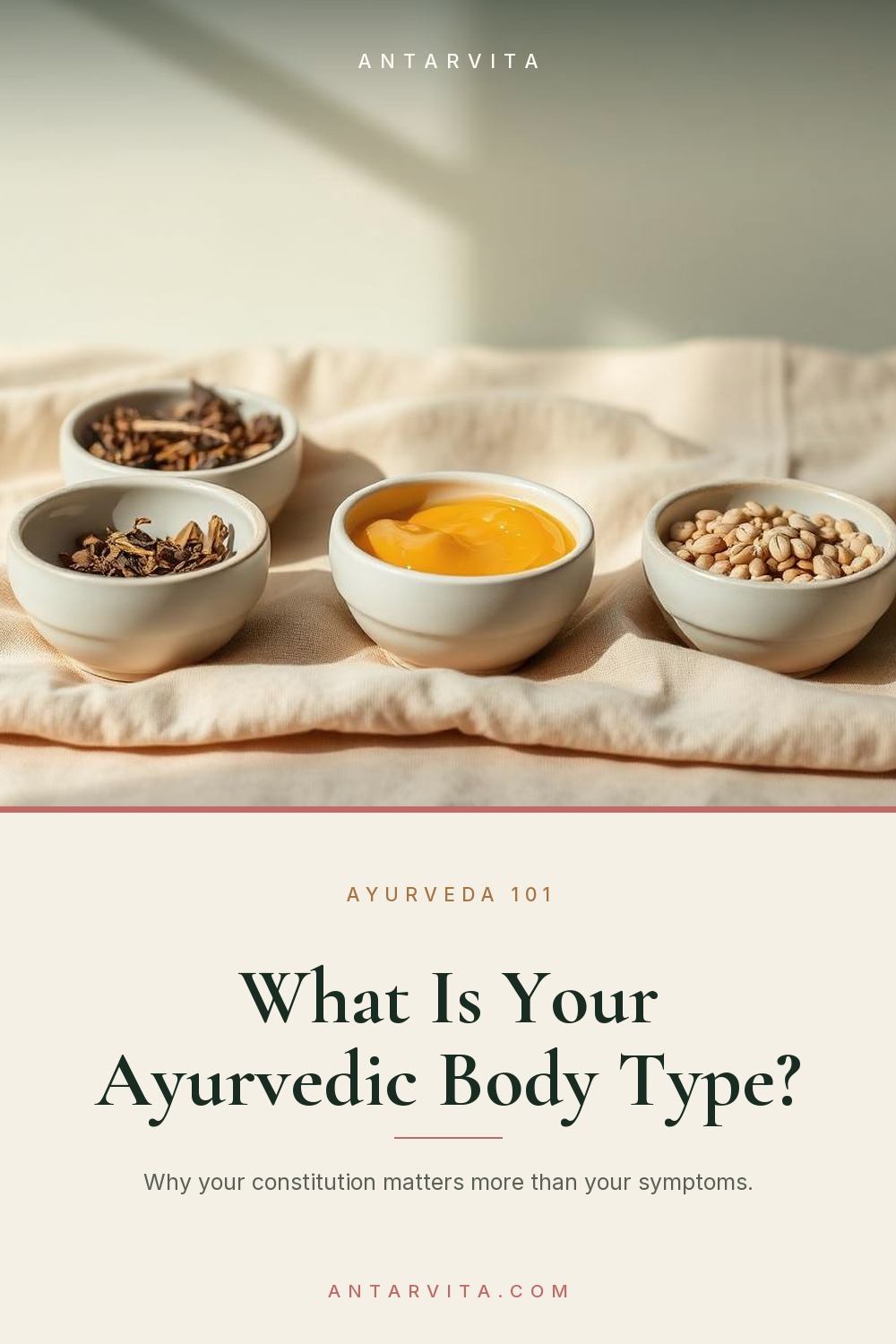
The herbs behind this article


Begin to understand your body through an Ayurvedic lens
If you want to understand your body through a personalized Ayurvedic lens, begin with the Libido Body Type Quiz or explore a private Antarvita consultation.
References
- Chopra, A., & Doiphode, V. V. (2002). Ayurvedic medicine: Core concept, therapeutic principles, and current relevance. Medical Clinics of North America, 86(1), 75–89. https://doi.org/10.1016/s0025-7125(03)00073-7
- Prasher, B., et al. (2008). Whole genome expression and biochemical correlates of extreme constitutional types defined in Ayurveda. Journal of Translational Medicine, 6(1), 48. https://doi.org/10.1186/1479-5876-6-48
- Rotti, H., et al. (2014). Determinants of Prakriti, the human constitution types of Indian traditional medicine and its correlation with contemporary science. Journal of Ayurveda and Integrative Medicine, 5(3), 167–175. https://doi.org/10.4103/0975-9476.140476
- Sharma, R., et al. (2019). Chyawanprash: A traditional Indian bioactive health supplement. Biomolecules, 9(5), 161. https://doi.org/10.3390/biom9050161