Shatavari for Women: The Evidence, the Ayurveda, and the Nightly Ritual
Short Answer
Shatavari (Asparagus racemosus) is the herb Ayurveda has used for female vitality for roughly three thousand years. Modern research describes it as an adaptogenic, antioxidant, mildly phytoestrogenic root with documented galactagogue activity and a favourable safety profile at customary doses (Alok et al., 2013; Bopana & Saxena, 2007; Gupta & Shaw, 2011). Women take it for hormonal steadiness, moisture, energy, mood and desire. It works slowly — think eight to twelve weeks of daily use.
Most women find Shatavari the way they find everything else in wellness: at two in the morning, on a phone, after months of being told that their labs are normal. The search usually starts with a symptom that is hard to say out loud — dryness, a libido that went quiet, a body that feels like it is running on fumes even though nothing is technically wrong. And then a root with a strange name keeps appearing.
This piece is the long version. What Shatavari is, what Ayurveda says it does and why, what the published research supports, where the evidence genuinely runs out, who it suits, who should avoid it, and how to take it in a way that survives real life.
What Shatavari Is
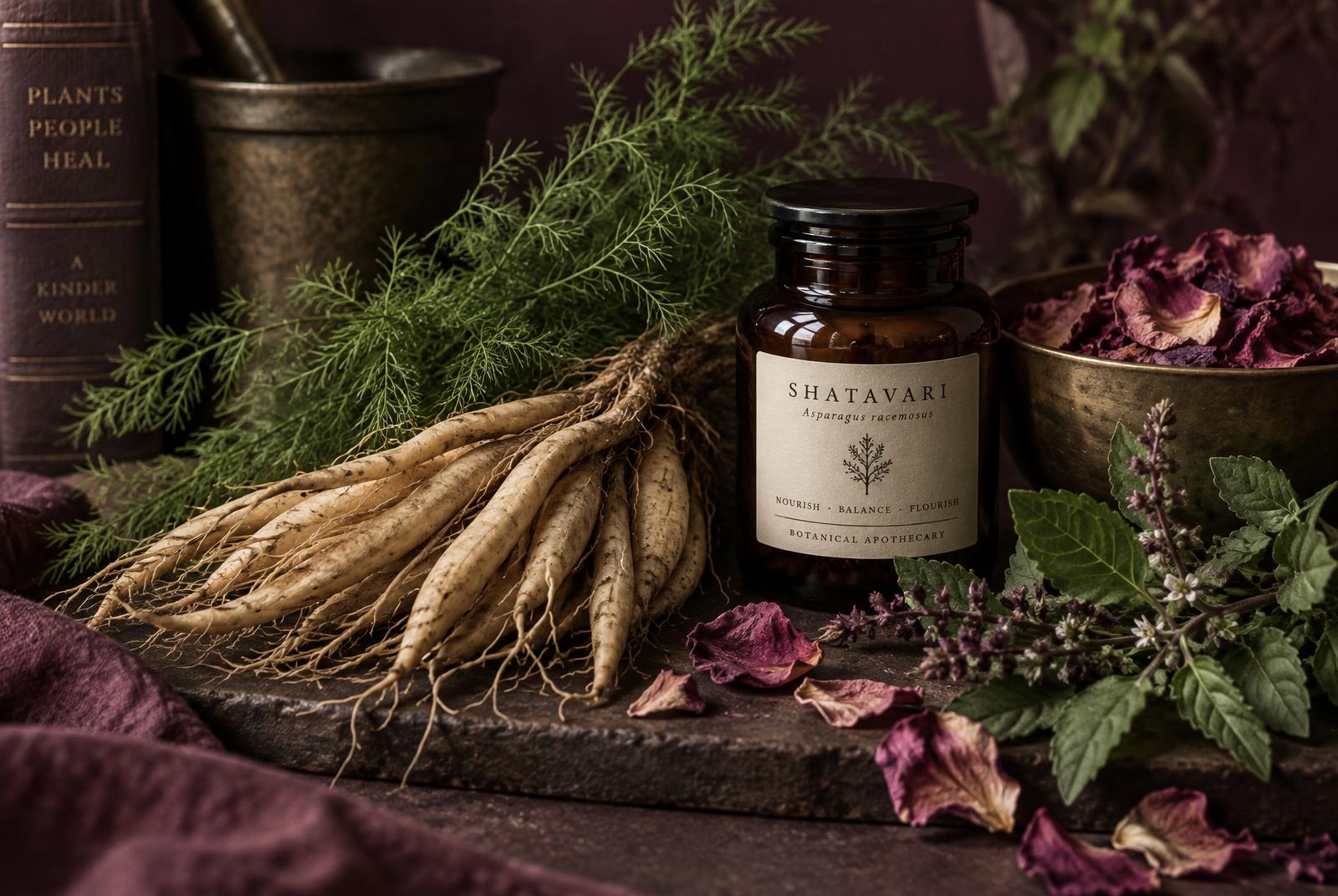
Shatavari is the root of Asparagus racemosus, a climbing perennial in the Asparagaceae family that grows across India, the Himalayan foothills, Sri Lanka and parts of Africa and Australia. The medicinal part is the tuberous root — pale, finger-like, and distinctly mucilaginous once prepared. Ethnopharmacological reviews describe it as one of the most widely used and most heavily harvested medicinal plants on the Indian subcontinent, valued primarily as a female tonic and general rejuvenative (Bopana & Saxena, 2007).
The Sanskrit name is usually translated as she who possesses a hundred husbands or, more literally, a hundred roots. Both readings point the same direction: this was the plant given to women whose vitality needed rebuilding, at every stage of life.
The chemistry, briefly
The best-characterised constituents are the steroidal saponins known as shatavarins, along with sarsasapogenin, polysaccharides and mucilage, flavonoids, sterols, isoflavones and trace alkaloids (Alok et al., 2013). The saponins and isoflavones are the reason Shatavari gets called phytoestrogenic; the mucilage and polysaccharides are almost certainly why it has such a long history of use for dry, irritated tissue and for the gut lining.
"Ashwagandha steadies a frayed nervous system. Shatavari refills the reservoir that nervous system has been drawing from."
The Ayurvedic Reasoning
In classical terms Shatavari is madhura (sweet) and tikta (bitter) in taste, sheeta (cooling) in energy, and madhura in post-digestive effect. It increases Kapha, pacifies Vata and Pitta, and is classified as a rasayana — a rejuvenative — with a specific affinity for artava dhatu (female reproductive tissue) and shukra dhatu, the tissue Ayurveda associates with fertility, vitality and creative force (Frawley & Lad, 2001; Lad, 2002).
That combination of qualities is the whole logic of the herb. A body that is dry, overheated, thin, wired and depleted is, in Ayurvedic language, a Vata-Pitta picture. Shatavari is sweet, cool and moist — the exact opposite qualities. Ayurveda does not treat the symptom; it applies the opposite quality until the tissue rebuilds. This is also why Shatavari is a poor choice for a body that is already damp, congested and sluggish.
Hormonal Balance: What Is Actually Known
Shatavari is not a hormone and it is not hormone replacement. What the literature describes is subtler: steroidal saponins and isoflavones with weak oestrogen-receptor affinity, alongside adaptogenic effects on the stress axis (Alok et al., 2013). In practice that means it appears to buffer rather than push — a modulating influence rather than a dose of anything.
The most interesting modern framing comes from a review examining the impact of chronic stress on female reproductive disorders, which proposes Shatavari as a plausible protective agent precisely because stress-driven cortisol and oxidative load disrupt ovarian and reproductive function (Pandey et al., 2018). That is worth sitting with. It reframes the herb not as a hormone lever but as something that lowers the physiological noise that is interfering with your hormones in the first place.
Where the evidence is genuinely strong: lactation. A double-blind, randomised, placebo-controlled trial in postnatal mothers found a significant increase in prolactin levels with Shatavari root powder compared with placebo (Gupta & Shaw, 2011). It is a small study, and one study is not a literature — but it is a real human trial with a real control group, which is more than most herbs in this category can claim.
Where the evidence is thinner: menopausal symptom relief, cycle regulation and PCOS. These are supported by centuries of clinical Ayurvedic use, animal work and traditional texts, but the human trial base is small and heterogeneous (Alok et al., 2013; Bopana & Saxena, 2007). Anyone telling you Shatavari is proven to fix your cycle is overselling it. Anyone telling you there is nothing there has not read the ethnopharmacology.
Vitality and the Stress Axis
Adaptogen is an overused word, but Shatavari earns a version of it. Preclinical work reports antioxidant, immunomodulatory, anti-inflammatory and antistress activity, along with a well-documented gastroprotective effect on the gut lining (Alok et al., 2013; Bopana & Saxena, 2007). Those are not glamorous findings, but they describe exactly the kind of low, structural depletion women actually live with: poor recovery, shallow energy, a digestive system that has quietly stopped absorbing well.
This is also where the contrast with ashwagandha matters. Withania somnifera has the stronger human evidence base for stress and cortisol outcomes (Speers et al., 2021), but it is warming and drying. For a woman who is already dry — dry skin, dry stools, thinning tissue, vaginal dryness, wired-and-exhausted — ashwagandha alone can sharpen the very dryness she came in with. The traditional answer is not either/or. Ashwagandha steadies. Shatavari rebuilds.
Mood, Nervous System and the Emotional Layer
Ayurveda treats mood as a tissue-level phenomenon rather than a separate department. A depleted body produces a depleted mood; ojas, the subtle end-product of good digestion and rest, is described as the substrate of both immunity and emotional steadiness. Shatavari is classified as an ojas-building herb, which is the traditional explanation for why women describe feeling less brittle on it rather than feeling anything dramatic (Frawley & Lad, 2001).
The modern reading is less poetic and points the same way: antistress and antioxidant activity in preclinical models (Alok et al., 2013), plus the stress-reproduction relationship outlined by Pandey et al. (2018). If your mood is being flattened by chronic depletion rather than by an acute clinical condition, a rebuilding tonic is a reasonable thing to reach for — alongside, never instead of, appropriate care.
Sensual Wellbeing: Desire, Moisture and Arousal
This is what most women are actually searching for, so let us be precise about it.
Shatavari is classified in the Ayurvedic materia medica as a vajikarana herb — the category concerned with reproductive vitality and sexual wellbeing — and as the principal one for women (Frawley & Lad, 2001; Lad, 2002). Its moistening, tissue-building action is the traditional rationale for its use in vaginal dryness and for the flat, absent quality of low desire that comes from depletion rather than from conflict or trauma.
Honest caveat: there is no large randomised trial of Shatavari for female sexual function. What exists is a long clinical tradition, a plausible mechanism through reproductive tissue nourishment and stress modulation (Pandey et al., 2018), and a very consistent pattern of reported experience. That is meaningful evidence of a kind. It is not proof, and I will not dress it up as proof.
What I will say clinically, after years of working with women in this exact place: desire that has gone quiet under stress rarely returns because of a single herb. It returns when the body stops living in emergency, digestion improves, sleep deepens, and the tissue has something to rebuild from. Shatavari belongs to that longer project.
The Companions: Tulsi and Cabbage Rose
Ayurveda almost never gives a single herb in isolation, and there is a reason the classical formulas for women pair Shatavari with aromatics.
- ◇Tulsi (Holy Basil, Ocimum sanctum) — the most-reviewed adaptogen in the Ayurvedic pharmacopoeia. A systematic review of human trials reported favourable effects across metabolic and psychological stress outcomes with good tolerability (Jamshidi & Cohen, 2017; Cohen, 2014). Tulsi settles the stress load so a rebuilding herb has somewhere to build.
- ◇Cabbage Rose (Rosa spp.) — cooling, aromatic and traditionally used for the heart and the pelvis. Reviews of Rosa damascena describe anxiolytic, antidepressant-like, anti-inflammatory and relaxant activity across preclinical and early human work (Mahboubi, 2016). Ayurveda uses rose to move stagnant heat out of the pelvis and to soften the emotional armour that depletion builds.
Shatavari rebuilds. Tulsi lowers the stress that caused the depletion. Rose opens the body back up to feeling. That is a formula with an internal logic, not a list of trending ingredients.
How to Take Shatavari
Traditionally, Shatavari is a powder stirred into warm milk with cardamom and a little ghee or honey — milk is the classical anupana, the delivery vehicle, because the active constituents are better carried in fat and because milk itself is tissue-building. Customary intake in traditional practice ranges roughly from three to six grams of root powder daily, taken consistently; standardised extracts are dosed far lower and vary by preparation, so follow the labelling on whatever you actually buy (Alok et al., 2013; Bopana & Saxena, 2007).
Three things determine whether it works for you:
- Consistency. Rasayana herbs are cumulative. Four nights a week for three months beats seven nights a week for eleven days.
- Digestion first. You cannot rebuild tissue on top of stagnation. If digestion is sluggish, clear the channels before you try to fill them.
- Time. Evaluate at eight to twelve weeks. Anything you feel in week one is likely to be the ritual, not the root — and the ritual counts, but it is not the herb.
The nightly version that actually happens
I love the warm milk ritual. I also know how few women are whisking bitter root powder into simmering milk at nine at night for twelve consecutive weeks, in the season of life when they need it most. The herb that works is the one you take.
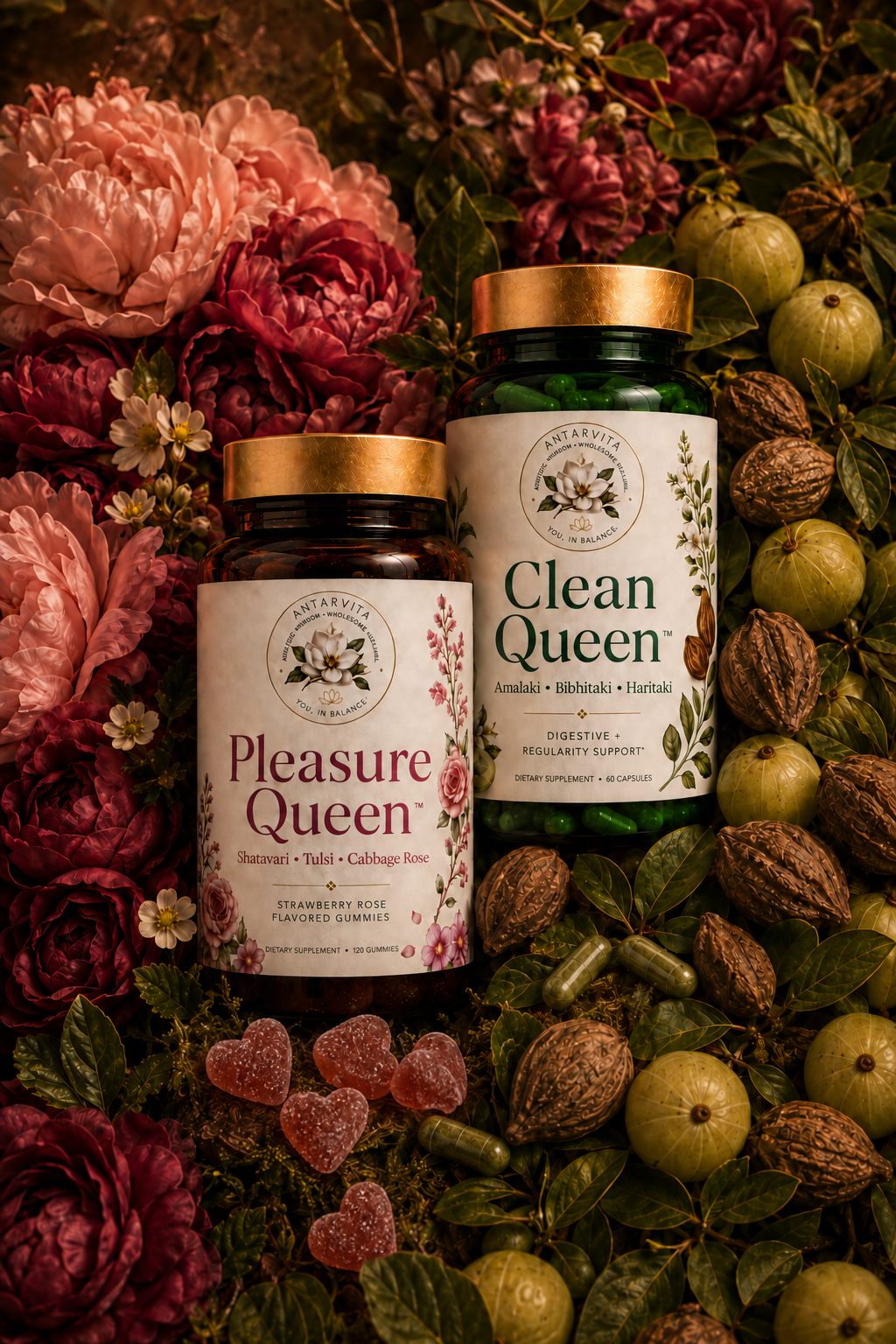
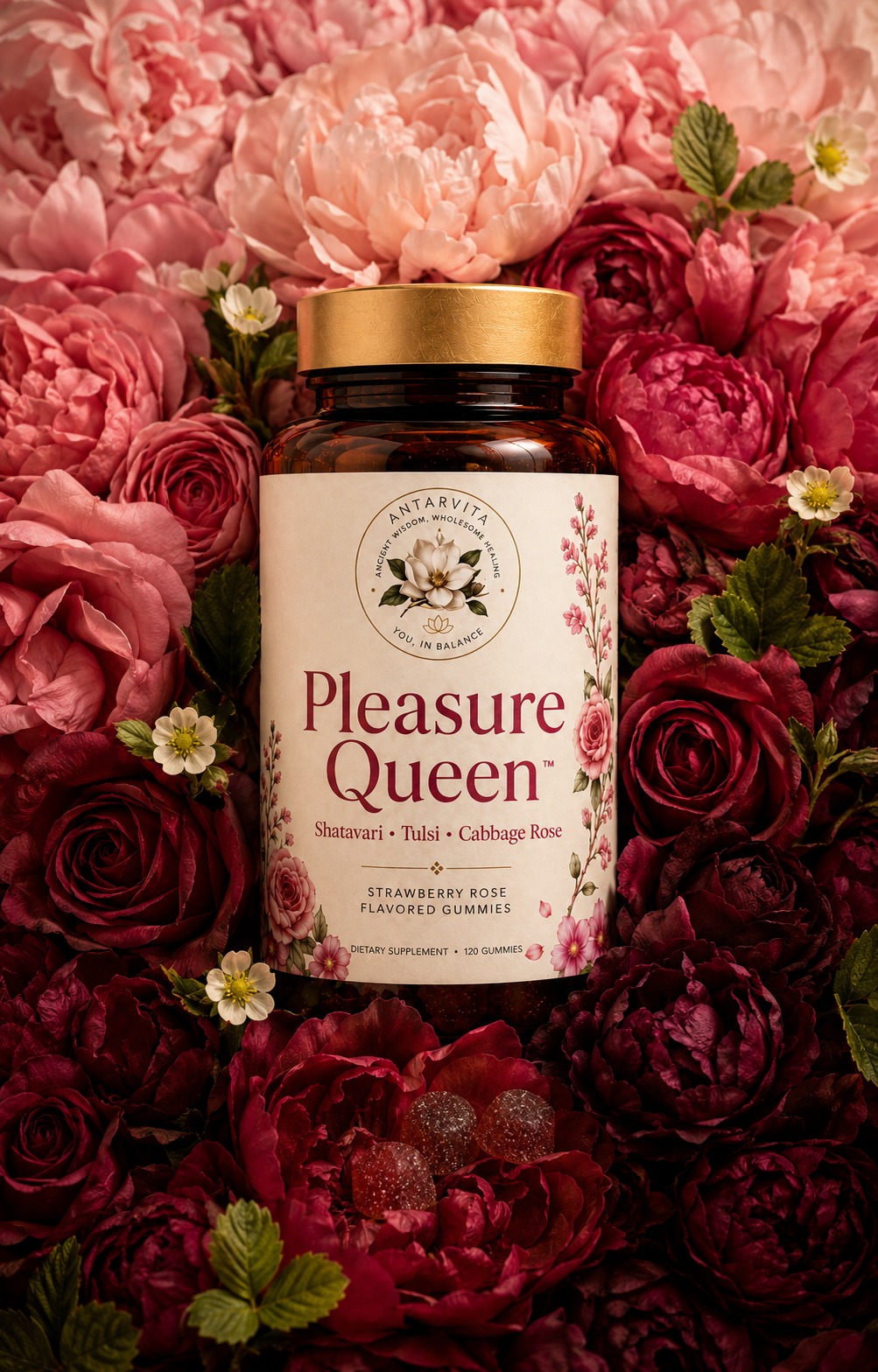
That is the entire reason Pleasure Queen™ exists — Shatavari at a real, meaningful potency, with Tulsi and Cabbage Rose, in an organically derived ingredients and sourced gummy you take by your bed at night. Same three herbs, same traditional logic, in a form that survives a Tuesday.
Safety, Contraindications and Honest Limits
Shatavari is generally well tolerated in the published literature at customary doses, with no significant toxicity reported in the reviewed preclinical and clinical work (Alok et al., 2013; Bopana & Saxena, 2007). That is reassuring, not a guarantee. Speak with your practitioner first if any of the following apply:
- ◇Allergy to asparagus or related plants.
- ◇Any oestrogen-sensitive condition — some fibroids, endometriosis, hormone-sensitive cancers. The phytoestrogen question is individual and unresolved.
- ◇Heavy Kapha patterns: congestion, mucus, water retention, sluggish digestion. Shatavari adds to damp.
- ◇Diuretics or lithium — Shatavari has mild diuretic activity.
- ◇Pregnancy, breastfeeding, or any prescription medication list.
And the limit worth naming plainly: Shatavari is a supportive tonic, not a treatment. Persistent dryness, pain with sex, cycle changes or exhaustion deserve a proper workup. Herbs sit alongside that work, not in place of it.
Frequently Asked Questions
Is Shatavari scientifically proven for women?
Partly. Its galactagogue effect has randomised, placebo-controlled human support (Gupta & Shaw, 2011), and reviews document antioxidant, adaptogenic and phytoestrogenic activity (Alok et al., 2013). Claims about libido, cycles and menopause rest mainly on traditional use and preclinical work.
Does Shatavari raise oestrogen?
It contains weakly phytoestrogenic compounds but it is not a hormone and does not act like one. The described effect is modulating rather than raising.
How long does Shatavari take to work?
Eight to twelve weeks of consistent daily use is the honest window. It builds tissue rather than stimulating a response.
Should I take it morning or night?
Evening suits most women. It is cooling and calming, and the nightly rhythm makes consistency far easier.
Can I take Shatavari with Tulsi and Rose?
Yes — it is a traditional combination. Tulsi addresses the stress load, rose the emotional and pelvic heat, Shatavari the rebuilding. This is the trio in Pleasure Queen™.
Educational content only. This article is not medical advice, diagnosis, or treatment, and these statements have not been evaluated by the Food and Drug Administration. Please consult a qualified healthcare practitioner before beginning any herbal, dietary, or wellness protocol, especially if pregnant, breastfeeding, taking medication, or managing a medical condition.
— Katy
Katy Kennedy, MS · Founder, Antarvita
Frequently asked questions
Is Shatavari scientifically proven for women?
Partly. Its effect on prolactin and lactation has randomised placebo-controlled human support, and reviews document antioxidant, adaptogenic and mildly phytoestrogenic activity. Claims about libido, cycles and menopause rest mainly on traditional Ayurvedic use and preclinical research.
Does Shatavari increase oestrogen?
It contains weakly phytoestrogenic saponins and isoflavones but it is not a hormone. The described action is modulating rather than raising oestrogen outright.
How long does Shatavari take to work?
Eight to twelve weeks of consistent daily use is the honest window. It rebuilds tissue rather than stimulating a quick response.
Can Shatavari be taken with Tulsi and rose?
Yes. It is a traditional pairing — Tulsi for the stress load, rose for pelvic and emotional heat, Shatavari for rebuilding. Antarvita's Pleasure Queen gummy combines all three in a nightly form.
Who should avoid Shatavari?
Anyone with an asparagus allergy, an oestrogen-sensitive condition, heavy congestion or damp Kapha patterns, or who is pregnant, breastfeeding or on medication should speak with a qualified practitioner first.
The herbs behind this article
Begin to understand your body through an Ayurvedic lens
If you want to understand your body through a personalized Ayurvedic lens, begin with the Libido Body Type Quiz or explore a private Antarvita consultation.
References
- Alok, S., Jain, S. K., Verma, A., Kumar, M., Mahor, A., & Sabharwal, M. (2013). Plant profile, phytochemistry and pharmacology of Asparagus racemosus (Shatavari): A review. Asian Pacific Journal of Tropical Disease, 3(3), 242–251. https://doi.org/10.1016/S2222-1808(13)60049-3
- Bopana, N., & Saxena, S. (2007). Asparagus racemosus — Ethnopharmacological evaluation and conservation needs. Journal of Ethnopharmacology, 110(1), 1–15. https://doi.org/10.1016/j.jep.2007.01.001
- Gupta, M., & Shaw, B. (2011). A double-blind randomized clinical trial for evaluation of galactogogue activity of Asparagus racemosus Willd. Iranian Journal of Pharmaceutical Research, 10(1), 167–172. https://pubmed.ncbi.nlm.nih.gov/24363697/
- Pandey, A. K., Gupta, A., Tiwari, M., Prasad, S., Pandey, A. N., Yadav, P. K., Sharma, A., Sahu, K., Asrafuzzaman, S., Vengayil, D. T., Shrivastav, T. G., & Chaube, S. K. (2018). Impact of stress on female reproductive health disorders: Possible beneficial effects of shatavari (Asparagus racemosus). Biomedicine & Pharmacotherapy, 103, 46–49. https://doi.org/10.1016/j.biopha.2018.04.003
- Jamshidi, N., & Cohen, M. M. (2017). The clinical efficacy and safety of tulsi in humans: A systematic review of the literature. Evidence-Based Complementary and Alternative Medicine, 2017, 9217567. https://doi.org/10.1155/2017/9217567
- Cohen, M. M. (2014). Tulsi – Ocimum sanctum: A herb for all reasons. Journal of Ayurveda and Integrative Medicine, 5(4), 251–259. https://doi.org/10.4103/0975-9476.146554
- Mahboubi, M. (2016). Rosa damascena as holy ancient herb with novel applications. Journal of Traditional and Complementary Medicine, 6(1), 10–16. https://doi.org/10.1016/j.jtcme.2015.09.005
- Speers, A. B., Cabey, K. A., Soumyanath, A., & Wright, K. M. (2021). Effects of Withania somnifera (ashwagandha) on stress and the stress-response system. Current Neuropharmacology, 19(9), 1468–1495. https://doi.org/10.2174/1570159X19666210712151556
- Frawley, D., & Lad, V. (2001). The yoga of herbs: An Ayurvedic guide to herbal medicine (2nd ed.). Lotus Press. https://www.lotuspress.com/
- Lad, V. (2002). Textbook of Ayurveda, Volume One: Fundamental principles. The Ayurvedic Press. https://www.ayurveda.com/textbook-of-ayurveda-volume-one/