Shatavari: The Herb That's Been Quietly Handling Women's Libido for 3,000 Years
Short Answer
Shatavari for women (Asparagus racemosus) is Ayurveda's premier female tonic — traditionally used for libido, vaginal moisture, hormone balance, postpartum recovery, and menopausal support. It's cooling, moistening, and works slowly: most women feel a shift in 4–12 weeks of daily use.
If ashwagandha is the herb everyone in the wellness aisle knows the name of, Shatavari is the herb Ayurvedic doctors have been quietly handing to women for about three thousand years. Its Sanskrit name translates, roughly, to she who possesses a hundred husbands — which is the kind of translation that gets used as a joke, but it's also a direct reference to how the tradition thought about this plant: as the herb that sustains a woman's vitality across every phase of her reproductive life.
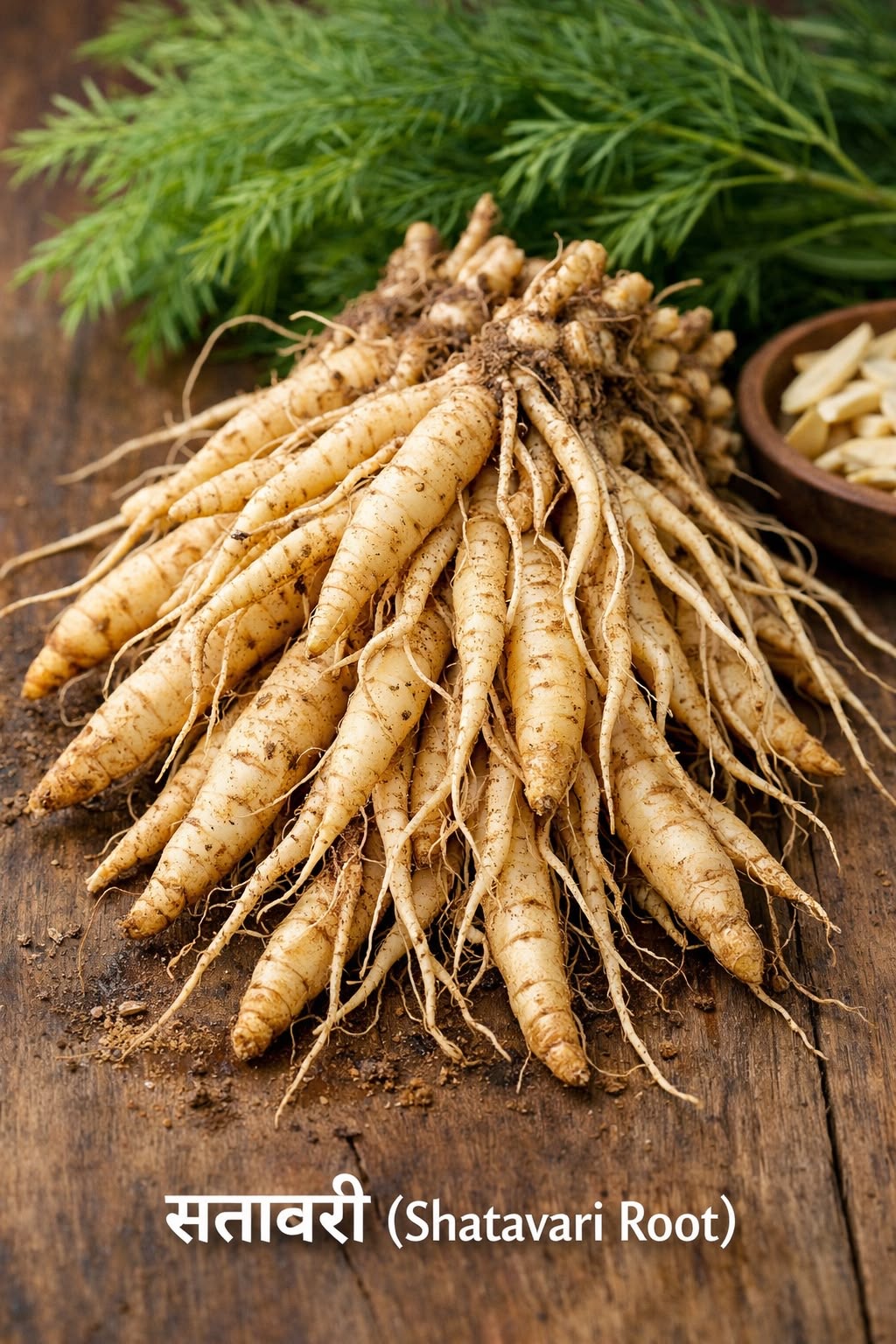
Shatavari (Asparagus racemosus) is a climbing plant in the asparagus family native to India and the Himalayas. The medicinal part is the root — long, pale, finger-like, and mucilaginous when prepared. That mucilage matters, because Shatavari's entire personality is cooling and moistening. That's what makes it so well-matched to the female body, and to almost every symptom women reach for adaptogens to fix.
"Ashwagandha steadies a frayed nervous system. Shatavari rebuilds a body that's run dry."
What Shatavari Actually Does in the Female Body
Ayurveda considers Shatavari a rasayana — a rejuvenative — specifically for the female reproductive tissue (artava dhatu) and for Shukra, the body's finest tissue of vitality and creative energy. In modern language, that maps onto four things it's traditionally used for:
- ◇Libido and lubrication — Shatavari is traditionally the go-to for vaginal dryness, low desire, and the "not-in-my-body" version of low libido.
- ◇Cycle and hormone support — used for irregular cycles, PMS heat and irritability, and perimenopausal shifts.
- ◇Postpartum recovery and lactation — one of the most well-documented traditional uses; often taken with warm milk after birth to rebuild tissue and support milk supply.
- ◇Menopausal comfort — cooling for hot flashes, moistening for dryness, calming for the sleep and mood shifts that come with the transition.
Emerging research supports several of these traditional uses. Randomized and controlled studies have documented Shatavari's role in menopausal symptom reduction, lactation support, and antioxidant/immunomodulatory activity — with a safety profile generally reported as favorable in typical doses. It's not a chemical hormone; it's a plant-tissue tonic that works with the body's own rhythms.
Ashwagandha vs. Shatavari — For Women, They're Not Interchangeable
Ashwagandha (Withania somnifera) is warming, drying, and grounding. It calms an overheated, over-thinking, over-caffeinated body — which is why it feels miraculous for anxiety and cortisol-driven exhaustion. But if a woman is already dry— dry skin, dry hair, thinning tissue, vaginal dryness, dry stools, wired-tired exhaustion — ashwagandha alone can make things worse before it makes them better.
Shatavari does the opposite. It's cool, moist, sweet, and rebuilds tissue. In most Ayurvedic protocols for women, ashwagandha and shatavari are taken together, not either/or — ashwagandha to steady the nervous system, shatavari to rebuild the reservoir of vitality it's been drawing from.
How to Take Shatavari (Without Wasting Twelve Weeks)
Traditionally, Shatavari is taken as a powder stirred into warm milk with a pinch of cardamom and a spoon of ghee or honey — milk is the classic anupana (delivery vehicle) because the herb is fat-soluble. Beautiful in theory. In practice, most modern women aren't warming milk at 9pm and whisking bitter root powder into it every single night for twelve weeks straight. And Rasayana herbs only work with consistency.
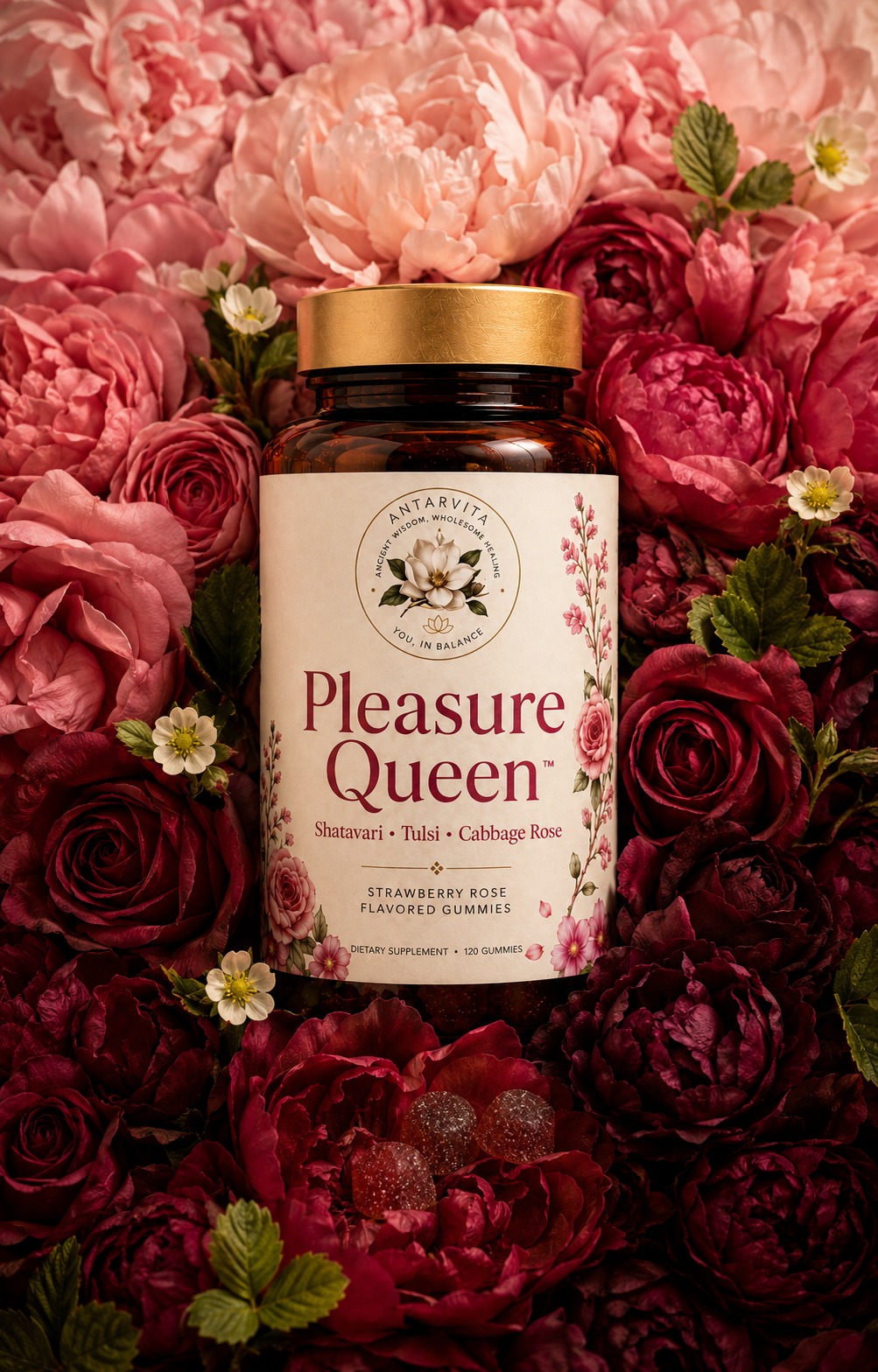
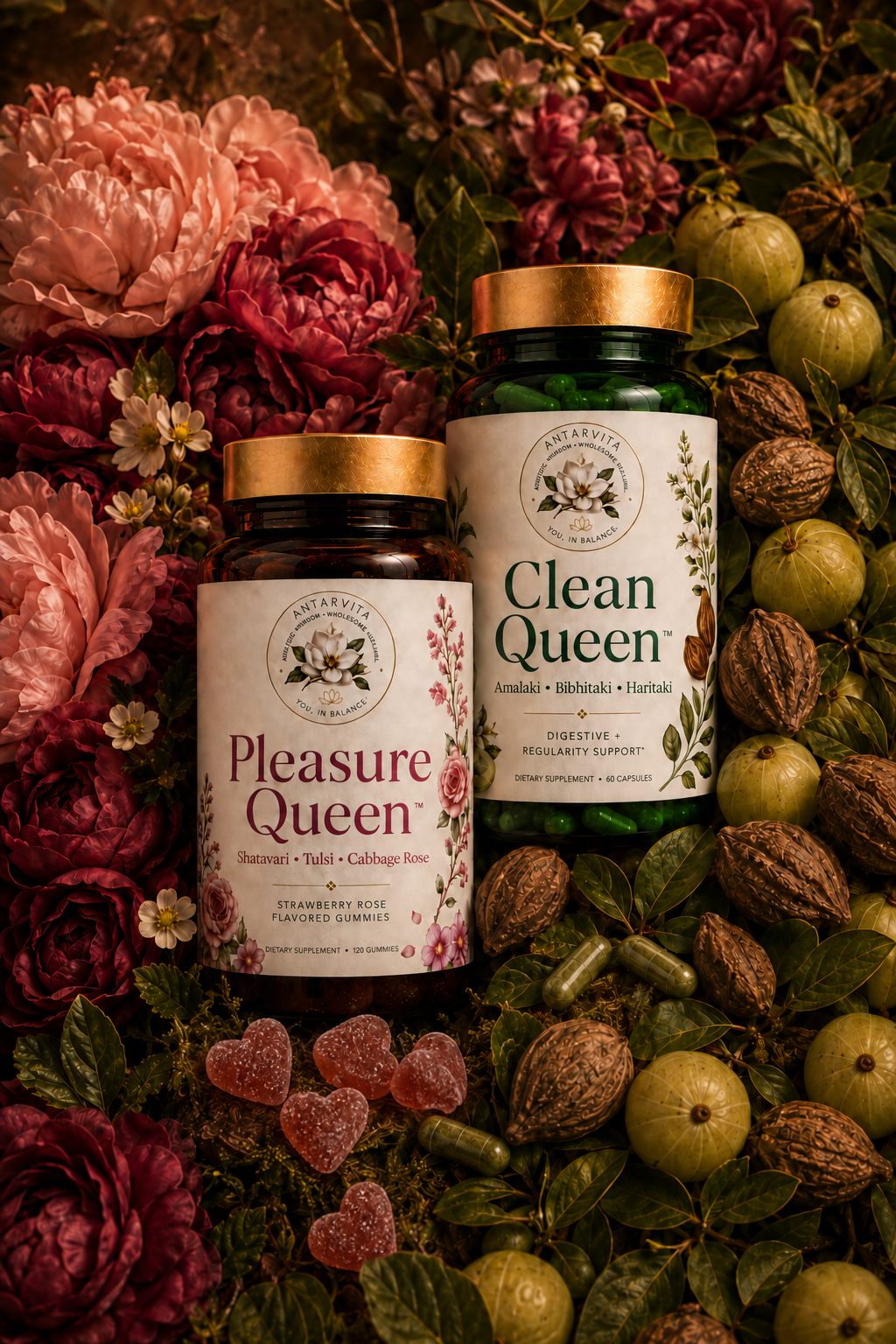
That's exactly why we built Pleasure Queen™ in a gummy — Shatavari at a real, therapeutic potency, paired with two herbs that make it work harder for the female body:
- ◇Holy Basil (Tulsi) — cooling and adaptogenic. It settles the heat of a stressed nervous system so Shatavari can actually rebuild, instead of trying to refill a body that's still burning.
- ◇Rose — supportive to the heart, the hormones, and the reproductive tissue. It softens the emotional edge of depletion, moves stagnant heat out of the pelvis, and opens the body back up to desire.
No offense to tradition — the warm milk ritual is beautiful and it works. This is about consistency. About a Shatavari protocol that actually fits into the modern woman's evening — a gummy ritual on the nightstand, next to the water glass — so the twelve weeks actually happen.
Who Should Be Careful With Shatavari
Shatavari is generally considered safe, but it isn't right for every body. Skip or ask your practitioner first if you have:
- ◇An asparagus or lily-family allergy.
- ◇An estrogen-sensitive condition (some fibroids, endometriosis, hormone-sensitive cancers) — check with your provider; the evidence is mixed and specific to the individual.
- ◇Heavy Kapha dampness (lots of mucus, congestion, sluggish digestion) — Shatavari can add to that pattern.
- ◇Diuretics or lithium — Shatavari has mild diuretic properties.
Pregnancy, breastfeeding, and any medication list all warrant a conversation with a qualified practitioner before starting.
The Female-Body Formula I Reach for Most
For most women I work with — especially the ones in the exhausted, dry, running-on-fumes season of life — the herbal foundation isn't a single supplement. It's a small, repeatable rhythm:
- Clear the channels first. A gentle daily Triphala at night to keep digestion moving. You cannot rebuild tissue on top of stagnation.
- Rebuild the reservoir. Shatavari + rose in warm milk in the evening — the moistening, rebuilding layer.
- Steady the nervous system. Ashwagandha in the morning, only if the body is warm-and-wired rather than cold-and-depleted.
This is exactly the logic behind Pleasure Queen™ — Shatavari with rose petal, tulsi, and a rebuilding female-body formulation rather than a borrowed-from-the-men's-aisle stimulant.
Frequently Asked Questions
What is Shatavari used for in women?
Traditionally: libido, vaginal moisture, cycle regularity, PMS and perimenopausal support, postpartum recovery, lactation support, and general reproductive tissue rejuvenation.
Does Shatavari increase estrogen?
It contains phytoestrogenic compounds and appears to have adaptogenic effects on the hormonal system, but it's not a hormone. It seems to help the body balance rather than raise estrogen outright.
How long until Shatavari works?
Most women feel a change in 4 to 12 weeks of daily use. This is a rebuilding herb, not a symptom fix.
Can I take Shatavari and ashwagandha together?
Yes, and this is the more traditional pairing for women — ashwagandha to calm, Shatavari to rebuild. Ashwagandha in the morning, Shatavari in the evening is a common rhythm.
Is Shatavari safe long-term?
Traditional use is long-term (months to years). Take breaks every few months, and check in with a qualified practitioner if you have any hormone-sensitive condition or take medication.
Educational content only. This article is not medical advice, diagnosis, or treatment. Please consult a qualified healthcare practitioner before beginning any herbal, dietary, or wellness protocol, especially if pregnant, breastfeeding, taking medication, or managing a medical condition.
— Katy
Katy Kennedy, MS · Founder, Antarvita
Frequently asked questions
What does shatavari do for women?
Traditionally it is used to support moisture in the reproductive tissues, steady cycles, ease hormonal heat and support desire. Its name translates loosely as she who possesses a hundred roots.
How much shatavari should I take daily?
Traditional use is a daily dose taken consistently with warm milk or water. Follow your product's labelling and check with your practitioner, especially if you are pregnant, breastfeeding or on medication.
How long does shatavari take to work?
Eight to twelve weeks of daily use is the honest window. It builds tissue rather than stimulating a response.
Who should not take shatavari?
Women with a history of hormone-sensitive conditions, active congestion or heavy Kapha patterns should speak with a practitioner first, as should anyone pregnant or on prescription medication.
The herbs behind this article
Begin to understand your body through an Ayurvedic lens
If you want to understand your body through a personalized Ayurvedic lens, begin with the Libido Body Type Quiz or explore a private Antarvita consultation.
References
- Pandey, A. K., et al. (2018). Asparagus racemosus (Shatavari): A review of its clinical and pharmacological uses in women's health. https://pubmed.ncbi.nlm.nih.gov/29635127/
- Gupta, M., & Shaw, B. (2011). A double-blind randomized clinical trial for evaluation of galactogogue activity of Asparagus racemosus. https://pubmed.ncbi.nlm.nih.gov/22131875/
- Alok, S., et al. (2013). Plant profile, phytochemistry and pharmacology of Asparagus racemosus (Shatavari): A review. https://doi.org/10.1016/S2221-1691(13)60049-3
- Lad, V. (2002). Textbook of Ayurveda, Volume One: Fundamental principles. The Ayurvedic Press. https://www.ayurveda.com/textbook-of-ayurveda-volume-one/