
We Are Not the Light Beer of Male Desire: 5 Things I Wish I'd Been Taught About Pleasure

Somewhere along the line, women were handed a version of sexuality that was really just male sexuality with the volume turned down. Same mechanism, same triggers, same expected arc — only softer, slower, a little more decorative. The light beer of what turns men on.
It is not a small error. It is the reason so many women assume something is wrong with them when the standard script doesn't work, and it's the reason the entire market built around female desire keeps selling friction to a body that is asking for safety.
1. Satisfaction is not one mode. It's a crossroads.
Sexual satisfaction for most women is not a single switch labeled stimulation. It is the meeting point of three things: confidence in your own body, genuine relaxation, and a felt sense of safety. Take any one away and the other two can't carry it. A woman can be touched perfectly and feel nothing if her body is braced. She can love her partner deeply and still feel far away if she spent the day being needed by everyone.
This is not a flaw in the design. It is the design.
It also tells you where the work begins. Not with technique, not with trying harder to want it — but with stress. Stress is the gateway. A woman under sustained pressure is not closed; she is occupied. Her system is spending its resources on vigilance, and reception is what gets set down first. Move the stress and you are not adding desire. You are freeing up the capacity to receive it.
2. Sex is not a drive
This is the line from Emily Nagoski's Come As You Are that rearranges everything. A drive is a survival mechanism — hunger, thirst, sleep. Deprive a body of those and it will die. Nobody has ever died of not having sex. As Nagoski puts it, sex is not a drive but an incentive motivation system: it responds to context rather than pushing from the inside.
She describes desire through a dual control model — an accelerator that notices everything sexually relevant, and brakes that notice every reason not to. For most women with low desire, the problem is almost never a weak accelerator. It's brakes held down by stress, exhaustion, body shame, resentment, a mental to-do list, an unlocked bedroom door. "The accelerator," she writes, "is the reason people have sex. The brakes are the reason they don't."
Which means the honest question is not how do I want more? It's what is my body still bracing against?
This is why stress work is not the boring preamble to the good part. It is the good part. Every long exhale, every finished stress cycle, every hour of real sleep lifts a foot off the brakes. Pleasure was never waiting on more input — it was waiting on a nervous system with enough room in it to feel.
3. Most of us have responsive desire — and were never told
Spontaneous desire — wanting sex out of nowhere — is the version every film, ad and sex-ed class treats as normal. It's also more common in men. Responsive desire, where wanting shows up after pleasure and safety begin, is the more common pattern in women, and it is not a lesser one.
The distinction matters because women with responsive desire spend years diagnosing themselves as broken while waiting for a feeling that was always meant to arrive second. Nothing is missing. The order of operations is simply different from the one you were sold.
And in that order, stress regulation comes before everything. If wanting arrives after safety and pleasure begin, then whatever helps your body settle — warmth, rhythm, breath, being unhurried, being held with no agenda — is not foreplay to the real event. It is the entry point. Reception opens first, and desire follows it in.
4. Stimulation without safety makes it worse
When I was twenty-one, I went to one of those sex-toy parties that come to your friend's house — the ones that arrive as a girls' night and leave as an invoice. Creams, wands, whips, rope, all of it promised to bring me closer to my partner. At one point in the evening we each took a turn in the bathroom, where a vanilla candle and a jar of tingling cream had been set on the back of the toilet. Everyone came out glowing about it, so when my turn came around the circle I went in, picked up the jar, and did what I always do first. I read the label.
Menthol.
So this was going to feel like arthritis cream on my vulva. And I was supposed to want to pay for that. I felt so much pressure in that room that I bought a forty-five-dollar jar of mint tingle anyway and threw it away a few weeks later.
Nothing at that party sold what every woman in that circle was actually there for: connection, safety, deeper bonding. It was a masculine idea of the female sex drive, wrapped in intimacy language and sold back to us at a premium through a girls-only MLM. Friction marketed as intimacy.
Here's the part that matters physiologically. When a woman who is already struggling with low desire is given more stimulation without the safety underneath it, her body doesn't warm. It braces. When sensation arrives at a nervous system that is still scanning for threat, the result is more detachment, more self-monitoring, more evidence for the story that she is the problem. In Nagoski's language, you have pressed the accelerator while standing on the brakes. The engine strains. Nothing moves.
I read Brian Alexander's America Unzipped years ago and wondered exactly what he wondered: why is this country so obsessed with sex and so frightened of talking about it? I suspect it's because talking honestly would mean unpacking the facts — that women's desire is contextual, relational, and genuinely different in architecture from men's. That's a harder thing to sell than a jar of cream.
Notice where that conversation was allowed to happen. Not in a doctor's office. Not in a health class. In a living room, after dark, with the blinds down and a hostess taking cash. Women's sexuality in this country doesn't get a storefront — it gets an underground market. Home parties, discreet packaging, unregulated formulas, whisper networks, a friend-of-a-friend who "knows a thing." The products are sold the way contraband is sold, and the framing follows the packaging: if it has to be hidden, it must be shameful, and if it's shameful, it can't be studied, funded, taught or examined in daylight.
That secrecy is not neutral. It is the mechanism. As long as the only places a woman can bring her questions are a shame-priced MLM circle, an algorithm and a comment section, no one is ever obligated to tell her the accurate thing — that her arousal is contextual, that responsive desire is a normal architecture, that her body asks for safety before sensation. Instead she gets a product. And a product has to imply a defect, because the defect is what creates the sale. The underground market cannot afford to describe her as functioning.
So the loop closes on itself. Because the topic stays hidden, it is rarely taken seriously clinically. Because it isn't taken seriously clinically, the loudest available answers come from people selling something. Because those answers are built on a masculine template — faster, harder, more friction, more urgency — they miss most women. And when they miss, the miss gets filed under her name instead of the product's. She leaves the party with a jar and a slightly heavier suspicion about herself.
Here is what gets lost in that shuffle. Female sexual response is not a quieter echo of male response. It is a complete, coherent, beautifully contexted system: brakes that read the environment before the accelerator means anything, desire that follows safety and touch rather than preceding them, arousal wired into the same nervous system that handles digestion, sleep, grief and rest. That is not a design flaw. That is an integrated body doing exactly what it was built to do — declining to open in conditions it has correctly read as unsafe, depleted or rushed.
A system like that does not need contraband. It needs daylight, language and accurate information. When women's sexuality is brought above ground and discussed as physiology — nervous system, digestion, tissue, rhythm, relationship — the question stops being what is wrong with her and becomes what conditions has she been asked to function in. That reframe is the whole shift. And it is why this conversation belongs in a consultation and a kitchen, not in a bathroom with a vanilla candle on the back of the toilet.
5. Safety isn't the only variable. Your digestion is in this too.
It would be tidy if safety explained everything. It doesn't. Plenty of women feel loved, safe and unhurried and still feel a low, flat, nonspecific blah in the body — the sense of moving through the day in a slightly damp coat.
Ayurveda has a word for this: ama. It's the sticky residue left when digestion doesn't complete — from food that was rushed, poorly combined, eaten late, or simply more than the digestive fire could process. Ama is heavy, dulling and mobile. It coats the tissues and mutes signal transmission, and the felt experience of it is exactly the one women describe when they say they feel foggy, sluggish, unattractive in their own skin and disinterested in being touched.
In Ayurvedic physiology, shukra dhatu — the reproductive tissue that governs vitality and radiance — is the last tissue to be formed from what you eat. It is fed last. Which means it is the first to be shorted when digestion is congested, sleep is thin, or elimination is incomplete. You cannot nourish that tissue while the channels feeding it are clogged. This is also why adding an adaptogen to a congested body so often does nothing at all.
Nagoski's Burnout, written with her sister Amelia, names the other half of it: stress and the stressor are two different things. Removing the deadline does not discharge the stress already living in your tissues. The cycle has to be completed — through movement, breath, sleep, affection, crying, something. A body that never completes the cycle stays in a low hum of vigilance, and vigilance and desire cannot occupy the same nervous system at the same time.
Which is the whole thesis in one line: managing stress is not adjacent to pleasure, it is the gate that pleasure comes through. A body still holding an unfinished stress cycle is a body organized around protection. A body that has completed it can soften, and a soft body can receive. Reception is the precondition for pleasure, and stress is what stands between most women and reception.
The trifecta
So here is what I wish someone had told me at twenty-one, instead of handing me a jar of menthol.
Eat in a way your body can actually digest. Warm, simple, unhurried food. Not perfection — completion. When digestion finishes its job, the heaviness lifts and the deeper tissues finally get fed.
Move, and let the stress finish. Walking, dancing, shaking, long exhales, being held. The point isn't fitness. The point is telling your body the danger has passed. This is the gateway step — when the stress cycle completes, the body shifts out of guarding and into receiving, and everything downstream becomes possible.
Build safety before you build stimulation. Safety is the ground floor. Confidence and relaxation grow out of it. Pleasure grows out of those.
There is nothing wrong with you. Your desire is not weaker, later, smaller or more complicated than it should be. It's contextual — which means it is responsive to what you give it. Remove what's congesting the body. Nourish the tissues. Regulate the nervous system. Tend the stress first and the rest stops being a struggle — a settled body is a receptive body, and a receptive body finds its way to pleasure on its own timeline, in its own order.
If you'd like to know which of those three your body is asking for first, the 2-minute Libido Body Type Quiz will tell you whether you're running hot, dry, or heavy — and what to begin with.
— Katy
Katy Kennedy, MS · Founder, Antarvita
Frequently asked questions
Why do women need to feel safe to want sex?
Desire is regulated by context, not by a biological drive. When the nervous system is scanning for threat — from stress, exhaustion, resentment or body shame — the brakes on arousal stay engaged. Safety releases the brakes, and only then does stimulation register as pleasure rather than pressure.
Is women's sexual desire different from men's?
Structurally, yes. Men more often experience spontaneous desire, which appears before any sexual context. Women more often experience responsive desire, which appears after pleasure and safety have begun. Neither is a weaker version of the other — they are different sequences.
What does Emily Nagoski mean when she says sex is not a drive?
In Come As You Are, Nagoski explains that a drive is a survival mechanism, like hunger or thirst, that a body will die without. Sex is not that. It is an incentive motivation system that responds to context — which is why changing the context changes desire more reliably than trying to force the feeling.
Can poor digestion cause low libido?
In Ayurveda, incomplete digestion produces ama, a heavy residue that dulls the tissues and creates a systemic flat feeling. Reproductive tissue, shukra dhatu, is the last tissue nourished from food, so it is the first to be shorted when digestion is congested. Clearing before nourishing is the traditional order for this reason.
Does using more stimulation help low desire?
It depends on context. In some situations, stimulation can help a woman feel more in the mood — a slow massage from a partner, for example, when she is already relaxed and present. But when a body is stressed or guarded, more stimulation often increases self-monitoring and detachment rather than arousal. The nervous system usually needs safety and relaxation first; stimulation tends to deepen what is already there.
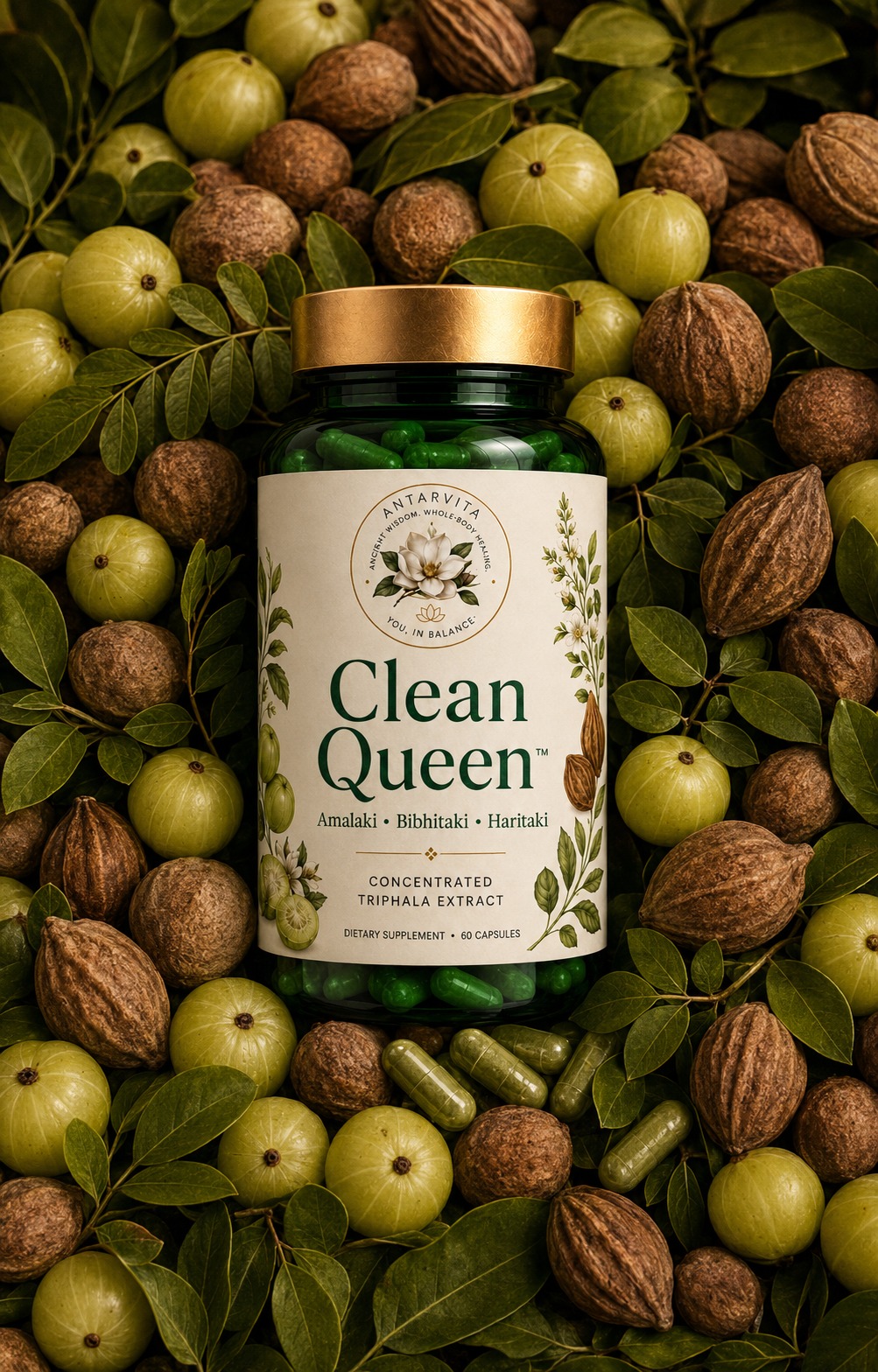
The herbs behind this article

Begin to understand your body through an Ayurvedic lens
If you want to understand your body through a personalized Ayurvedic lens, begin with the Libido Body Type Quiz or explore a private Antarvita consultation.
References
- Nagoski, E. (2015). Come As You Are: The Surprising New Science That Will Transform Your Sex Life. https://www.emilynagoski.com/come-as-you-are
- Nagoski, E. & Nagoski, A. (2019). Burnout: The Secret to Unlocking the Stress Cycle. https://www.emilynagoski.com/burnout
- Alexander, B. (2008). America Unzipped: In Search of Sex and Satisfaction. https://www.penguinrandomhouse.com/books/298214/america-unzipped-by-brian-alexander/
- Basson, R. (2001). Human sex-response cycles. Journal of Sex & Marital Therapy, 27(1), 33–43. https://pubmed.ncbi.nlm.nih.gov/11224935/
- Meston, C. M., & Buss, D. M. (2007). Why humans have sex. Archives of Sexual Behavior, 36(4), 477–507. https://pubmed.ncbi.nlm.nih.gov/17610060/
- Alok, S., et al. Plant profile, phytochemistry and pharmacology of Asparagus racemosus (Shatavari): A review. Asian Pacific Journal of Tropical Disease. https://pmc.ncbi.nlm.nih.gov/articles/PMC4027290/