Why Ashwagandha Isn't Fixing Your Low Libido (And What Ayurveda Would Try Instead)
You bought the ashwagandha. Maybe the maca too, or the little bottle of horny goat weed that showed up in your algorithm at 11pm during one of those why don't I want this anymore spirals. You took it consistently. You waited.
And your desire didn't come back.
Here's the thing nobody tells you: most of the herbs marketed for "libido" were studied on, and formulated for, a male reproductive system. A man's arousal is often mechanical — blood flow, testosterone, done. A woman's arousal is contextual. It asks a question first: is it safe to want this right now? No herb answers that question. Ayurveda has been trying to for about three thousand years, and it starts somewhere most supplement bottles never mention — your nervous system, your pelvic floor, and something called Shukra.
"A woman's arousal isn't a weak accelerator. It's a brake that's been pressed down for so long it feels like the default."
The Missing Piece: Desire Isn't Just Chemical, It's Conditional
Sex researcher Emily Nagoski, in Come As You Are, describes female arousal as having an accelerator and a brake — and for most women, low libido isn't a weak accelerator. It's a brake that's been pressed down for so long it feels like the default. Stress, safety, resentment, exhaustion, a nervous system stuck in fight-or-flight: all of it presses the brake, regardless of how much ashwagandha is circulating in your bloodstream.
Ayurveda would nod at this and add a layer: it calls the vital, reproductive essence of the body Shukra — the finest, most refined product of digestion, the tissue Ayurveda considers responsible for vitality, fertility, and sexual and creative energy. Shukra isn't built by taking a supplement. It's built (or depleted) by how well you digest your food, your stress, and your life. If your Agni — your digestive fire, the thing that transforms food and experience into usable energy — is weak or overtaxed, there's nothing left over to become Shukra. You can't supplement your way around a body that's still in survival mode.
Why the Body Says No Before the Mind Does
This is where it gets interesting, and where most libido content stops short. In Ayurvedic and somatic thinking alike, the pelvic floor isn't just muscle — it's where a huge amount of unprocessed stress physically lives. A chronically tense pelvic floor can't fully relax, and a body that can't relax can't feel much of anything, arousal included. Burnout, in Nagoski's other book of the same name, describes this as a body stuck mid-stress-cycle, unable to complete it and return to safety. An un-completed stress cycle and a gripped pelvic floor tend to arrive together.
This isn't really about gender — it's about polarity. The receptive, "feminine" energy in any body (regardless of who's in it) needs to feel safe, slow, and nourished before it opens. The pursuing, "masculine" energy can move fast and mechanical. Desire changes show up almost universally as a mismatch here: the nervous system is being asked to receive while it's still braced for impact.
A simple practice
Pelvic Floor Breathing — 3 to 5 minutes
- Lie down or sit comfortably. Place one hand low on your belly, one on your inner thigh.
- Inhale slowly through the nose for a count of four, imagining the breath moving down into your pelvis, allowing it to soften and widen — not clench.
- As you inhale, picture a warm, rose-pink light filling the hips and low belly.
- Exhale for a count of six, letting the jaw, the glutes, and the pelvic floor release completely.
- Repeat for 3–5 minutes, ideally before bed or before any moment you want to feel present in your body.
This is not a performance exercise. It's a safety signal — you're teaching the nervous system that this part of the body is allowed to be soft.
The Skin–Libido Connection Nobody Talks About
There's more overlap between your skin's glow and your sexual vitality than most skincare marketing admits. Ayurveda ties both back to the same tissue layers — when Shukra and Ojas (the body's reserve of vitality, resilience, and radiance) are well-nourished, it tends to show up as glow, plumpness, and a kind of visible aliveness in the skin. When they're depleted — from undigested stress, poor sleep, or chronic dryness (a Vata pattern) — both skin and libido can go dull at the same time. If your skin has felt flat and your desire has felt distant in the same season, Ayurveda would say: same root, two symptoms.
One Thing Female Bodies Do Differently
Here's something worth sitting with: in most Ayurvedic and tantric frameworks, the female energetic system isn't depleted by climax the way the male system typically is. Without a specific retention practice, ejaculation in the male body tends to require a recharge period. The female system, by contrast, is generally described as becoming more magnetic, more invigorated, and more energetically alive through pleasure — not less. Which means the "I'm too tired for sex" story often has it backwards. Pleasure, approached with safety and presence, can be a source of energy — not a withdrawal from it.
A Simple Rhythm: Medicate, Meditate, Masturbate
Not a slogan for shock value — a genuinely useful Ayurvedic-adjacent framework for keeping feminine energy circulating rather than stagnant:
Medicate — supportive herbs (Shatavari, Ashwagandha taken correctly and consistently, not as a rescue remedy, Gokshura) can help rebuild Shukra over time, but they support a foundation — they don't replace one.
Meditate — even five minutes of the pelvic floor breathing above, daily, keeps the nervous system out of constant defense mode.
Masturbate — solo pleasure, approached without pressure or a goal, is one of the simplest ways to keep this energetic system moving rather than dormant. Ayurveda would frame this as maintaining flow in a system that stagnates when ignored.
What Tongue and Pulse Have to Do With Any of This
One of the more beginner-friendly entry points into Ayurveda is simply learning to check in with your own body — starting with the tongue. A quick look each morning (coating, color, cracks) is a small daily practice of returning attention inward, which is, not coincidentally, the same skill that supports arousal. You cannot be turned on and dissociated from your body at the same time. Tongue analysis and pulse analysis aren't diagnostic magic — they're a repeatable ritual of re-entering the body, which is most of the work.
Where to Start This Week
You don't need to overhaul your life. Pick one:
- ◇Do the pelvic floor breathing practice nightly for one week.
- ◇Look at your tongue each morning before coffee — just notice, don't judge.
- ◇Swap "rescue remedy" ashwagandha (taken once, hoping for a same-night effect) for a consistent daily dose over 6–8 weeks, paired with better sleep.
None of this is about forcing desire to appear on command. It's about removing what's pressing the brake, so the body has room to want something again.
A Small Sanskrit Glossary
- Shukra
- The most refined tissue (dhatu) produced by digestion; associated with reproductive vitality, fertility, and sexual and creative energy.
- Agni
- Digestive fire; the body's ability to digest, transform, and assimilate food and experience.
- Ojas
- Vital essence associated with resilience, nourishment, glow, and vitality.
- Vata · Pitta · Kapha
- The three doshas — movement, transformation, and structure — that map every body's constitution.
Disclaimer: This article is for educational purposes only and is not medical advice. Herbs, supplements, foods, and wellness practices may not be appropriate for everyone. Please consult your healthcare practitioner before beginning any herbal, dietary, or wellness protocol, especially if you are pregnant, breastfeeding, taking medication, managing a medical condition, or experiencing persistent symptoms. By choosing to follow any suggestions shared here, you are responsible for checking with your healthcare practitioner and monitoring your own reactions, sensitivities, and side effects.
— Katy
Katy Kennedy, MS · Founder, Antarvita
Frequently asked questions
Does ashwagandha increase libido in women?
It can, for women whose low desire comes from depletion and anxiety. For women whose picture is dryness, heat or irritability, it often does nothing — or adds heat.
What is the best herb for female libido?
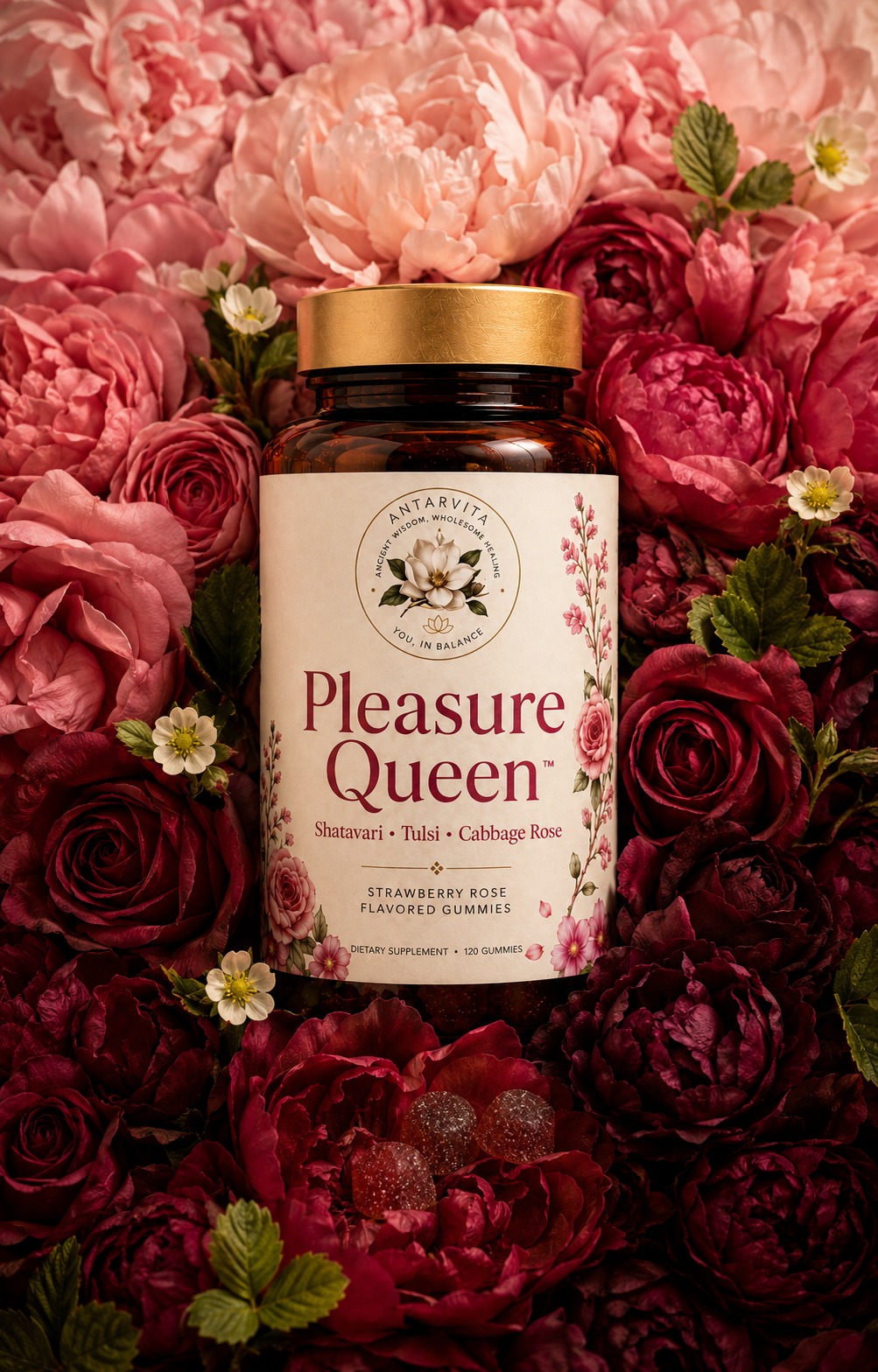
In Ayurveda, shatavari is the primary rasayana for women — traditionally used for moisture, reproductive tissue and desire. It is usually paired with rose and tulsi rather than taken alone.
Shatavari or ashwagandha — which should I take?
Ashwagandha for depletion, anxiety and a wired-tired nervous system. Shatavari for dryness, heat, low moisture and low desire. Many women benefit from both, in the right order.
How long until a libido herb works?
Traditional rasayanas work at tissue level. Expect eight to twelve weeks of consistent daily use before judging results.

The herbs behind this article
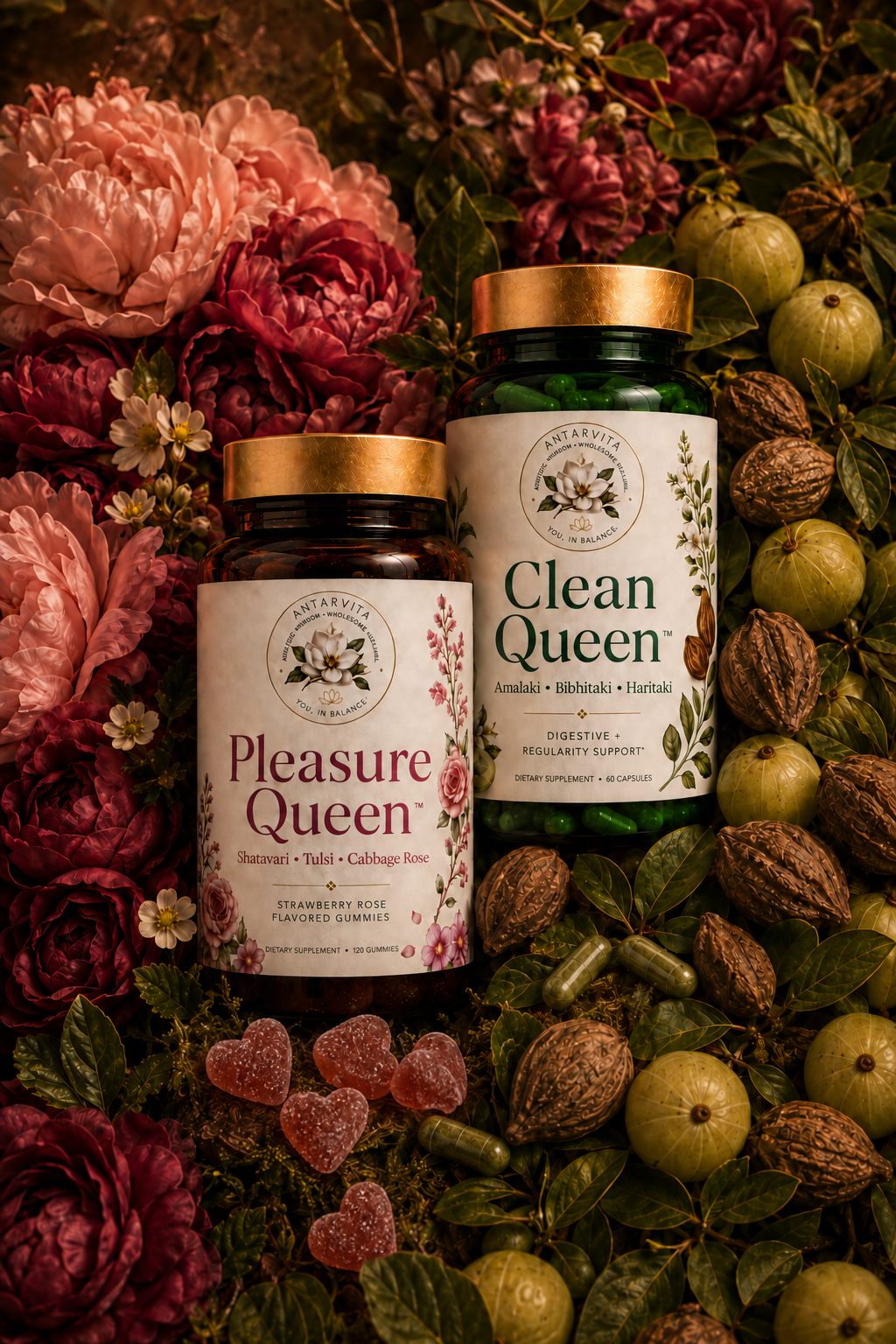
Begin to understand your body through an Ayurvedic lens
If you want to understand your body through a personalized Ayurvedic lens, begin with the Libido Body Type Quiz or explore a private Antarvita consultation.
References
- Nagoski, E. (2015). Come as you are: The surprising new science that will transform your sex life. Simon & Schuster. https://www.emilynagoski.com/come-as-you-are
- Nagoski, E., & Nagoski, A. (2019). Burnout: The secret to unlocking the stress cycle. Ballantine Books. https://www.emilynagoski.com/burnout
- Sarris, J., et al. (2019). Withania somnifera (ashwagandha) in sexual dysfunction: A systematic review. Journal of Ethnopharmacology. https://doi.org/10.1016/j.jep.2019.01.038
- Pelvic floor muscle training and female sexual function: A systematic review and meta-analysis. (PMC12247012) https://pmc.ncbi.nlm.nih.gov/articles/PMC12247012/
- The role of pelvic floor rehabilitation in female sexual dysfunction. (PMC11330551) https://pmc.ncbi.nlm.nih.gov/articles/PMC11330551/
- Lad, V. (2002). Textbook of Ayurveda, Volume One: Fundamental principles. The Ayurvedic Press. https://www.ayurveda.com/textbook-of-ayurveda-volume-one/