Yoni Eggs, Yea or Nay?
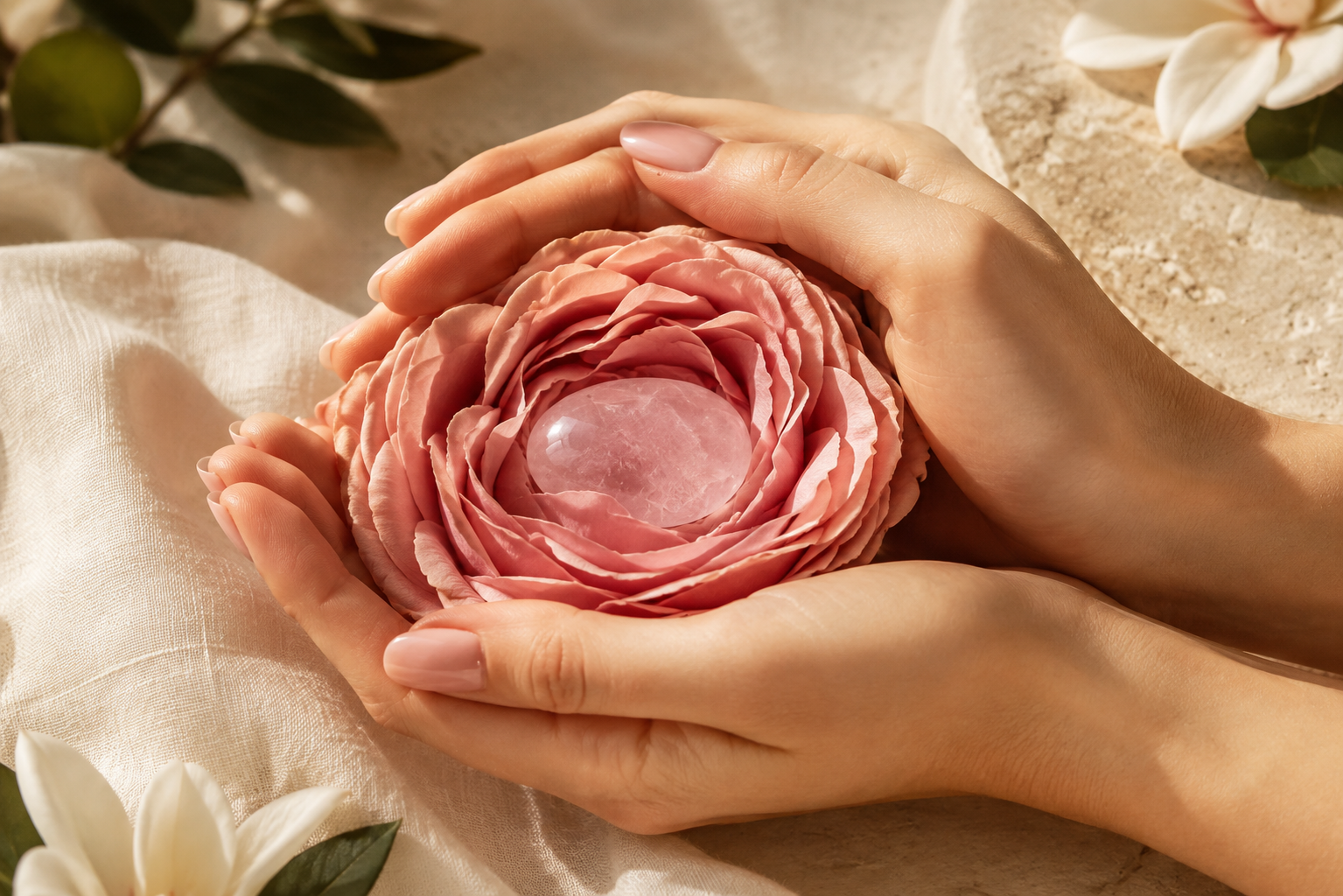
They show up in your feed wrapped in silk, photographed on marble, promising everything from ironclad pelvic muscles to "awakened feminine energy." Yoni eggs — smooth stone eggs, usually jade or rose quartz, worn internally — are one of the most searched and least honestly discussed objects in women's wellness.
So: yea or nay? The real answer is more interesting than either. Let's take the history, the claims, the safety, and the Ayurvedic reading one at a time.
→ New to Ayurveda? Start with your constitution, the beginner's entry point to Ayurveda. It'll make everything below land faster.
What is a yoni egg?
Yoni is a Sanskrit word for the womb, the vulva, and the sacred source — a word that carries reverence, not clinical distance. A yoni egg is a polished, egg-shaped stone, roughly the size of a small plum or smaller, inserted vaginally and held for a period of time. They're sold in jade, rose quartz, obsidian, and amethyst, often drilled for a retrieval string.
The stated uses fall into three buckets: physical (pelvic floor strength and tone), sensory (increasing internal awareness and sensation), and energetic or ritual (connection to the pelvis as a seat of creativity and desire). Those three things are not the same, and most marketing blurs them into one promise.
The history of yoni eggs — how long have they really been used?
Here's where honesty matters more than mystique. The story you'll read almost everywhere is that jade eggs were a secret practice of ancient Chinese royalty, guarded for thousands of years in the imperial palace. It is a beautiful story. Historians of Chinese medicine and Chinese art have found no textual or archaeological evidence for it. Jade was profoundly significant in Chinese culture — burial objects, ritual objects, status objects — but the specific practice of vaginally worn jade eggs does not appear in the classical medical record.
What is well documented is that the modern yoni egg trend emerged from the late twentieth-century Taoist sexual practice revival in the West and went fully mainstream after 2017, when a wellness brand's jade egg marketing drew a widely reported consumer protection settlement in California over unsubstantiated health claims.
The practice of intentional pelvic training, though, genuinely is old. Traditions across India, China, and the Middle East describe pelvic breath, internal awareness, and sexual continence practices. In Ayurveda and classical yoga, the relevant technology isn't a stone — it's the breath and the bandhas, particularly Mula bandha, the root lock. That lineage is real and documented. The egg is a modern object attached to an older idea.
What are yoni eggs used for — and do they work?
The most common claim is pelvic floor strengthening. Physiologically, holding an object internally does create resistance you can contract against, which is the same principle behind medical-grade vaginal weights used in supervised pelvic floor therapy. So the mechanism isn't nonsense.
The problem is the assumption underneath it: that a weak pelvic floor is the issue in the first place. For a large share of the women I see — stressed, over-scheduled, running a nervous system that has been "on" for a decade — the pelvic floor isn't weak. It's overactive. Chronically braced. And adding a clenching practice to a floor that already can't let go is like prescribing more grip to hands that are already cramped.
Pelvic health research is fairly clear that an overactive pelvic floor is associated with pain, reduced sensation, and sexual difficulty. If that's your pattern, more tightening is the wrong direction.
Padoa, McLean, Morin, and Vandyken (2021), writing in Sexual Medicine Reviews, describe the overactive pelvic floor as a driver of dyspareunia, vaginismus, and reduced sexual function — and note that treatment centers on downtraining and relaxation, not strengthening. Rosenbaum (2007) makes the same point from the pelvic rehabilitation side: pelvic floor muscles must be able to both contract and fully relax for normal sexual response. Bø (2004) adds the training caveat — resistance devices only produce benefit when contraction technique is correct and verified, which is why supervised assessment matters more than the object you buy.
Yoni egg safety: what to actually know
- Porosity. Jade and many crystals are porous and can be micro-fractured. Porous material cannot be reliably sterilized, which raises reasonable concern about bacterial harboring. Body-safe silicone or medical-grade materials do not have this issue.
- Duration. Sleeping with an egg in, or wearing one all day, is commonly recommended online and is exactly the practice most likely to encourage sustained involuntary clenching.
- Retrieval. Undrilled eggs with no string can be difficult to remove, particularly if pelvic muscles are gripping.
- Contraindications. Pelvic pain, painful sex, prolapse, active infection, pregnancy, or postpartum recovery all warrant a pelvic floor physical therapist before any internal device.
The historical claim has been examined directly in the medical literature: Gunter and Parcak (2019), an obstetrician-gynecologist and an archaeologist writing in Female Pelvic Medicine & Reconstructive Surgery, reviewed museum jade collections and the archaeological record and found no evidence that jade eggs were used vaginally in ancient China. They also raise the porosity and biofilm concern explicitly. On the strengthening side, the Cochrane review of weighted vaginal cones (Herbison & Dean, 2013) found only limited, low-quality evidence of benefit for incontinence — and cones are the studied, medical-grade version of this idea.
How to tell if a yoni egg is right for you
Skip the marketing and start with your own body. This is the screen I walk women through.
Signs it is probably not right for you (for now)
- Sex is painful, burning, or feels like hitting a wall at entry.
- You have pelvic pain, tailbone or hip pain, or pain with tampons or speculum exams.
- You pee frequently, feel urgency, or have trouble fully emptying — all common with an overactive floor, not just a weak one.
- Constipation, straining, or a pelvis that never feels "loose."
- You cannot consciously release your pelvic floor. Try it now: contract, then let go completely. If nothing distinctly releases, that's your answer.
- Pregnancy, early postpartum, active infection, prolapse, or an IUD insertion or procedure within the last several weeks.
Signs it may be reasonable to explore
- You have been assessed by a pelvic floor physical therapist and told your floor is underactive rather than overactive.
- You can contract and fully release on command, and you can feel the difference.
- No pain with penetration, exams, or daily movement.
- Your interest is sensory and ritual — internal awareness, slowing down, reconnecting — rather than fixing a symptom.
- You'll use a body-safe, non-porous material with a retrieval string, for short sessions, never overnight.
One honest filter: if you are buying it to solve something, it is the wrong tool. If you are using it to notice something, it may have a place.
And if you're unsure which category you're in, that itself is the referral. A pelvic floor physical therapist can tell you in one visit what a year of internet reading cannot.
None of this means "never." It means the honest verdict is conditional: a yoni egg is a tool, not a treatment, and the wrong tool for the most common pattern.
The Ayurvedic perspective on the pelvic floor
Ayurveda doesn't ask "is this muscle strong?" It asks "what quality is moving here?" Chronic pelvic gripping reads as aggravated Vata — the dosha of air and space, governing movement and the nervous system. Aggravated Vata is dry, cold, mobile, and guarded. In the pelvis it shows up as tightness, thinning moisture, muted sensation, and a body that flinches toward protection rather than opening.
The pelvis is also the seat of Apana vayu, the downward and outward current of Prana responsible for menstruation, elimination, birth, and orgasm. Apana's job is release. When we train the pelvis exclusively in gripping, we are working directly against the direction that current is designed to move.
And underneath both sits Shukra dhatu — the subtlest of the seven tissues, associated with reproductive vitality. Shukra is built last from strong digestion (Agni) and depleted first under stress, which is why low desire so often arrives holding hands with fatigue, dryness, and unreliable digestion.
The Ayurvedic answer to a tight, dry, under-sensitive pelvis isn't more contraction. It's warmth, oil, breath, slowness, and safety.
If you clench, you must also release
Here is the rule I'd want every woman to keep, whether or not she ever buys an egg: tone requires both directions. A muscle is only strong if it can fully contract and fully lengthen. Kegels, eggs, weights, "tightening" programs — none of them build function if the release half is missing. They build a floor that is short, stiff, and quietly numb.
Sensation lives in the release. Blood flow returns on the exhale. Arousal is a parasympathetic event — it happens in the state your body reaches when it stops bracing. You cannot clench your way into receiving.
→ Want the deeper version of this? Pelvic floor release and desire goes further into the Shukra connection.
A 5-minute pelvic floor release and breathwork practice
Do this before any strengthening work — and ideally before bed, when your nervous system is most willing to cooperate. No equipment. No goal.
- Set up. Lie on your back, knees bent and falling slightly open, feet flat, a pillow under your head. Let your lower back be heavy. Rest one hand on your low belly.
- Unclench the outposts. Soften your jaw, your tongue, your throat. Fascially and neurologically, jaw and pelvis travel together — a locked jaw keeps the floor locked too.
- Inhale down, not up. Breathe slowly through the nose for a count of four and let the breath travel all the way to the pelvic floor, allowing it to widen and blossom outward. Most of us reflexively clench on the inhale. Reverse it deliberately.
- Exhale long and let go. Exhale for a count of six through slightly parted lips. On the way out, release the glutes, the inner thighs, the low belly. Six out, four in — the longer exhale is what signals safety to the nervous system.
- Add warmth. On each inhale, imagine soft rose-gold light filling the hips and pelvis. In Ayurveda, breath paired with visualization is a real method for directing Prana into a specific region.
- Repeat 8–10 rounds, then lie still for thirty seconds and notice what's different. That noticing is the practice.
Once release feels available — meaning you can consciously soften the floor on demand — then a gentle strengthening practice makes sense, ideally with a pelvic floor physical therapist who can tell you which pattern you actually have.
How this ties back to libido
Desire is not a willpower problem. It's a state. Women's arousal is far more tied to nervous system safety, context, and blood flow returning to a relaxed pelvis than it is to muscular grip strength. Which is why a stone egg rarely delivers what the caption promised — it's answering a question most women aren't actually asking.
The sequence that does tend to move things: regulate the nervous system, teach the pelvis to release, restore moisture and digestion, and then nourish the tissue underneath.
→ Not sure which pattern is yours? The 2-minute Libido Body Type Quiz is the fastest honest starting point.
Where herbs come in
Breath handles the nervous system. Herbs handle the terrain. In Ayurveda, the pelvis doesn't get nourished in isolation — it gets nourished downstream of digestion, because Shukra is built from what Agni successfully transforms.
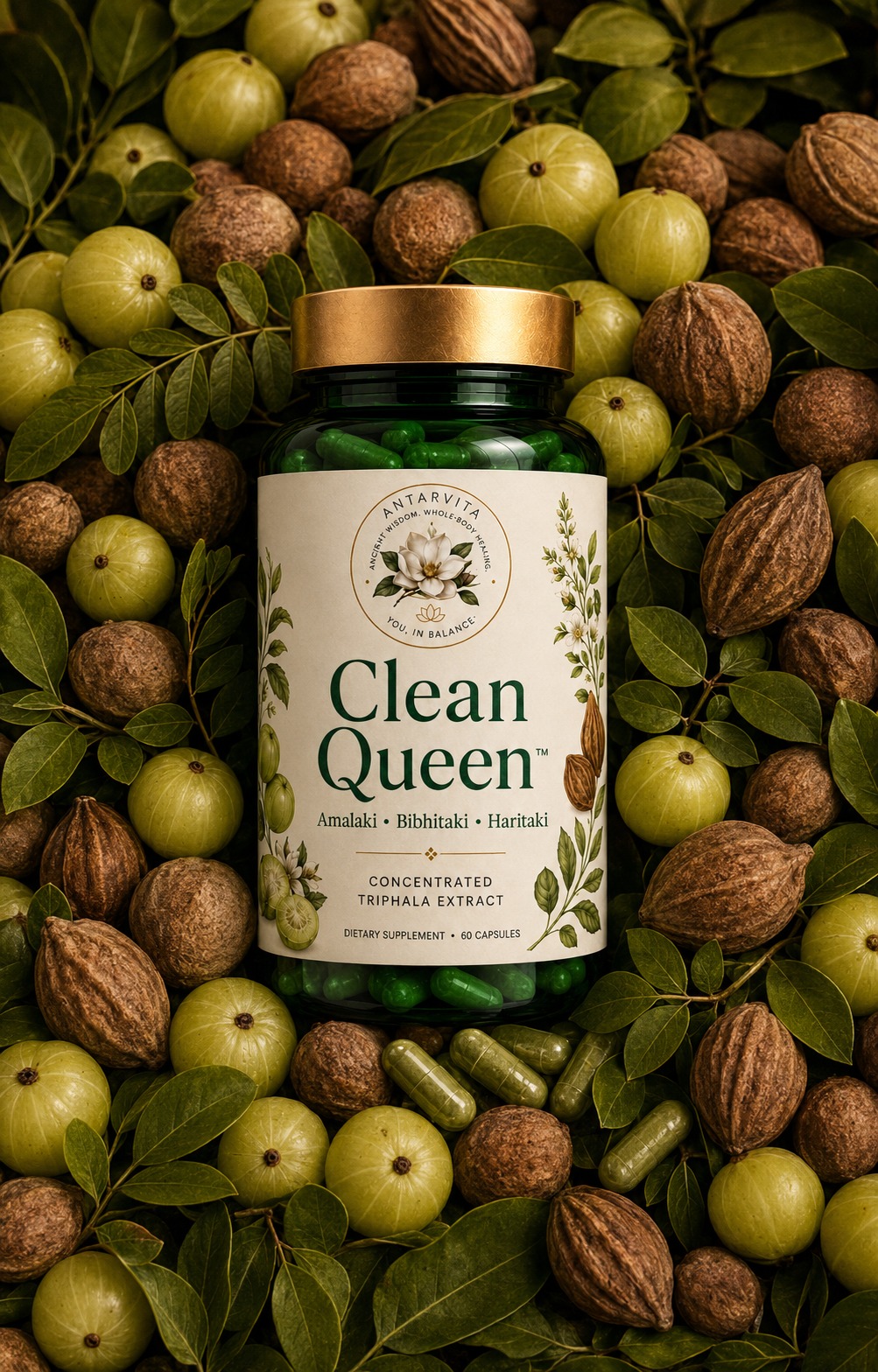
That's the logic behind starting with Clean Queen™, built on organic Triphala, the classical formula traditionally used to support gentle elimination and digestive balance — clearing the channels first — before layering in Shatavari, Tulsi, and Cabbage Rose, herbs traditionally used in Ayurveda to support the female reproductive system, moisture, and a calmer relationship to stress.
No herb overrides a braced pelvic floor, and no capsule replaces the five minutes of breathing above. Herbs support the terrain; the breath changes the state. Together they're doing two different jobs.
→ Book a consultation if you want your own pattern mapped rather than guessed at.
So — yea or nay?
Nay as an ancient secret, a libido cure, or an all-day habit. Nay if you have pelvic pain, painful sex, prolapse, or a floor that's already gripping — which is most women reading this.
A qualified yea as an occasional body-safe tool for internal awareness, if you already know how to release, you keep sessions short, and you've been cleared by someone who examined you.
The eggs were never the technology. Your breath was.
Sanskrit term index
- Yoni — Sanskrit for the womb and vulva; also "source" or "origin."
- Vata — The dosha of air and space, governing movement and the nervous system. Aggravated Vata is dry, cold, and guarded.
- Apana vayu — The downward-moving current of Prana seated in the pelvis, governing elimination, menstruation, birth, and orgasm. Its direction is release.
- Mula bandha — The root lock; a classical yogic engagement of the pelvic floor, traditionally taught alongside equally deliberate release.
- Shukra dhatu — The subtlest of the seven tissues, associated with reproductive vitality; built last, depleted first.
- Agni — Digestive fire; the body's capacity to transform food and experience.
- Prana — Life-force energy, closely tied to breath and directable through attention.
This article is for educational purposes only and is not medical advice. Herbs, supplements, foods, and wellness practices may not be appropriate for everyone. Please consult your healthcare practitioner before beginning any herbal, dietary, or wellness protocol, or before using any internal device, especially if you are pregnant, breastfeeding, postpartum, taking medication, managing a medical condition, or experiencing pelvic pain or persistent symptoms. By choosing to follow any suggestions shared here, you are responsible for checking with your healthcare practitioner and monitoring your own reactions, sensitivities, and side effects.
— Katy
Katy Kennedy, MS · Founder, Antarvita
Frequently asked questions
Do yoni eggs actually work?
A yoni egg can provide resistance to contract against, similar in principle to vaginal weights used in supervised pelvic floor therapy. But most women with low sensation or low desire have an overactive, chronically braced pelvic floor rather than a weak one, and additional clenching can make that worse. Release work comes first.
How long have yoni eggs been used?
The popular claim that jade eggs were used by ancient Chinese royalty for thousands of years is not supported by historical or archaeological evidence. The documented trend is modern, emerging from a late twentieth-century Western revival of Taoist sexual practices and going mainstream after 2017. Intentional pelvic breath and lock practices, however, are genuinely ancient in yoga and Ayurveda.
Are yoni eggs safe?
Jade and many crystals are porous and cannot be reliably sterilized, which raises bacterial concerns. Prolonged wear encourages sustained clenching, undrilled eggs can be difficult to retrieve, and anyone with pelvic pain, painful sex, prolapse, infection, pregnancy or postpartum recovery should see a pelvic floor physical therapist before using any internal device.
What does Ayurveda say about the pelvic floor?
Ayurveda reads chronic pelvic gripping as aggravated Vata — dry, cold, mobile and guarded. The pelvis is the seat of Apana vayu, the downward current governing elimination, menstruation and orgasm, whose natural direction is release. The Ayurvedic response is warmth, oil, breath, slowness and safety rather than more contraction.
How do I release my pelvic floor instead of clenching it?
Lie on your back with knees bent, soften the jaw, inhale for four counts letting the pelvic floor widen rather than grip, then exhale for six while releasing the glutes, inner thighs and low belly. Repeat eight to ten rounds nightly. The longer exhale signals safety to the nervous system.
Do yoni eggs help with libido?
There is no good evidence that yoni eggs increase desire. Women's arousal is closely tied to nervous system safety and blood flow returning to a relaxed pelvis, which is why pelvic release, digestion and stress support tend to matter more than muscular grip strength.
How do I know if a yoni egg is right for me?
It is likely not right for you if you have pelvic pain, painful sex, urinary urgency, constipation, prolapse, active infection, pregnancy or early postpartum recovery, or if you cannot consciously release your pelvic floor after contracting it. It may be reasonable to explore if a pelvic floor physical therapist has assessed your floor as underactive, you can contract and fully release on command, you have no pain, and you use a non-porous body-safe egg with a retrieval string for short sessions only.
The herbs behind this article
Begin to understand your body through an Ayurvedic lens
If you want to understand your body through a personalized Ayurvedic lens, begin with the Libido Body Type Quiz or explore a private Antarvita consultation.
References
- Bø, K. (2004). Pelvic floor muscle training is effective in treatment of female stress urinary incontinence, but how does it work? International Urogynecology Journal, 15(2), 76–84. https://pubmed.ncbi.nlm.nih.gov/15014933/
- Padoa, A., McLean, L., Morin, M., & Vandyken, C. (2021). The overactive pelvic floor and sexual health. Sexual Medicine Reviews, 9(1), 76–92. https://pubmed.ncbi.nlm.nih.gov/32631813/
- Rosenbaum, T. Y. (2007). Pelvic floor involvement in male and female sexual dysfunction and the role of pelvic floor rehabilitation in treatment. Journal of Sexual Medicine, 4(1), 4–13. https://pubmed.ncbi.nlm.nih.gov/17233772/
- Gunter, J., & Parcak, S. (2019). Vaginal jade eggs: ancient Chinese practice or modern marketing myth? Female Pelvic Medicine & Reconstructive Surgery, 25(1), 1–2. https://pubmed.ncbi.nlm.nih.gov/30045037/
- Herbison, G. P., & Dean, N. (2013). Weighted vaginal cones for urinary incontinence. Cochrane Database of Systematic Reviews. https://pubmed.ncbi.nlm.nih.gov/23821367/
- Faubion, S. S., Shuster, L. T., & Bharucha, A. E. (2012). Recognition and management of nonrelaxing pelvic floor dysfunction. Mayo Clinic Proceedings, 87(2), 187–193. https://pmc.ncbi.nlm.nih.gov/articles/PMC3498251/
- Wallace, S. L., Miller, L. D., & Mishra, K. (2019). Pelvic floor physical therapy in the treatment of pelvic floor dysfunction in women. Current Opinion in Obstetrics and Gynecology, 31(6), 485–493. https://pubmed.ncbi.nlm.nih.gov/31609735/
- Basson, R. (2001). Human sex-response cycles. Journal of Sex & Marital Therapy, 27(1), 33–43. https://pubmed.ncbi.nlm.nih.gov/11224935/